Whole Milk Regains Clinical Relevance in the GLP-1 Treatment Era

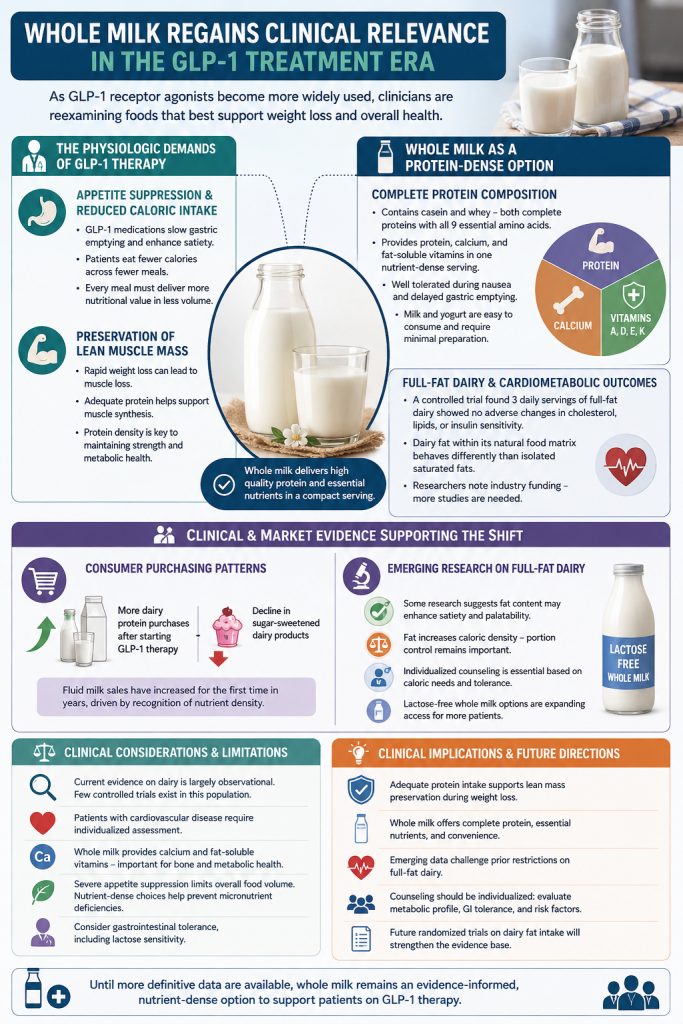
The expanding use of GLP-1 receptor agonists has altered dietary patterns. Medications like Wegovy suppress appetite and reduce overall caloric intake. Consequently, clinicians are reexamining foods that best support pharmacologic weight loss. Whole milk is regaining attention as a protein-dense option for these patients.
The Physiologic Demands of GLP-1 Receptor Agonist Therapy
Appetite Suppression and Reduced Caloric Intake
GLP-1 receptor agonists mimic an endogenous hormone that slows gastric emptying. Along with this, the mechanism effectively enhances satiety signaling. Patients typically consume fewer calories across fewer eating occasions. Clinical data show individuals using these agents reduce daily calories substantially.
This caloric reduction necessitates a highly deliberate nutrient selection process. Each meal must deliver greater nutritional value within a smaller volume. Given this, dietitians advocate for foods packing high protein density.
Preservation of Lean Muscle Mass
Rapid weight reduction carries a risk of disproportionate lean tissue loss. Studies indicate lost weight often derives heavily from skeletal muscle. To be precise, adipose tissue is not the sole source of weight loss. Adequate protein intake directly mitigates this risk by supporting muscle synthesis.
Consequently, clinicians prioritize protein density when counseling these patients. A caloric deficit demands optimal nutritional efficiency to preserve strength. Furthermore, proper dietary planning ensures patients maintain adequate metabolic health.
Whole Milk as a Protein-Dense Dietary Option
Complete Protein Composition
Milk contains casein and whey as its two primary proteins. Both proteins supply all nine essential amino acids required daily. This composition effectively classifies dairy as a complete protein source. Hence, it distinguishes dairy from many incomplete plant-based alternatives.
Whole milk delivers protein alongside calcium and fat-soluble vitamins. It provides these nutrients efficiently within a highly compact serving. In light of this, nutrient density becomes clinically vital for patients.
Dietitians note dairy proteins are well tolerated during gastrointestinal distress. Nausea and delayed gastric emptying often complicate standard meal consumption. Milk and yogurt offer easily consumed alternatives requiring minimal preparation. Accordingly, clinicians frequently recommend these practical options to patients.
Full-Fat Dairy and Cardiometabolic Outcomes
Historical dietary guidance previously discouraged whole milk consumption completely. Guidelines cited its saturated fat content and presumed cardiovascular risks. Newer research has fundamentally questioned this rigid categorical restriction. Therefore, medical professionals are reconsidering dairy fat restrictions.
A controlled trial compared low-dairy and higher-dairy intake patterns. Overweight adults consumed three daily servings of full-fat dairy. Participants demonstrated no adverse changes in blood cholesterol or lipids.
Moreover, insulin sensitivity remained stable throughout the study duration. Dairy fat behaves differently within its native food matrix. Building on this, it acts differently than isolated saturated fats. Nevertheless, researchers caution that industry funding warrants careful study interpretation.
Clinical and Market Evidence Supporting the Shift
Consumer Purchasing Patterns
Retail data provide corroborating evidence for this nutritional shift. Surveys indicate patients purchase more dairy proteins after beginning therapy. Simultaneously, purchases of sugar-sweetened dairy products have declined notably. Thus, patients exhibit reduced tolerance for calorie-dense sweet foods.
Industry analysts describe this shift as a notable consumption reversal. Fluid milk sales recently increased for the first time in years. Analysts attribute this increase to growing recognition of nutrient density.
Emerging Research on Full-Fat Dairy
Ongoing research examines whole milk advantages over reduced-fat alternatives. Some scientists argue fat content enhances satiety and improves palatability. Others emphasize that fat content inherently increases dietary caloric density. Consequently, clinicians must evaluate caloric limits within restricted intake patterns.
Given this tension, individualized counseling remains the preferable approach. Lactose tolerance also represents a significant clinical consideration for patients. Delayed gastric emptying can amplify gastrointestinal symptoms in susceptible individuals.
Manufacturers have responded by expanding lactose-free whole milk formulations. This development grants broader patient access to essential dairy benefits. As a result, patients avoid exacerbating uncomfortable digestive discomfort.
Clinical Considerations and Limitations
Clinicians must recognize that current dairy evidence remains largely observational. Few controlled trials examine dairy fat intake within this population. Therefore, recommendations should draw on established general nutritional principles. Providers should not presume causal benefits from whole milk specifically.
Patients with cardiovascular disease warrant individualized assessment before dietary changes. Micronutrient adequacy represents a primary concern during reduced caloric intake. Whole milk directly provides calcium and essential fat-soluble vitamins. Along with this, these nutrients support bone health and metabolism.
Severe appetite suppression directly limits overall daily food volume. Nutrient-dense choices help offset the risk of micronutrient insufficiency. Accordingly, dietitians should incorporate this consideration into specialized nutrition plans.
Clinical Implications and Future Directions
Pharmacologic therapy and protein-dense nutrition converge in modern guidance. Evidence confirms adequate protein intake supports lean mass preservation. Whole milk offers a complete amino acid profile alongside vitamins.
Emerging research challenges prior categorical dietary restrictions regarding full-fat dairy. Studies suggest full-fat dairy does not uniformly worsen cardiometabolic markers. Nevertheless, clinicians must individualize dietary counseling based on metabolic profiles. Professionals must evaluate gastrointestinal tolerance and cardiovascular risk carefully.
Nutrition guidance will require ongoing refinement as medication use expands. Future randomized trials examining dairy fat intake would strengthen evidence. Until then, whole milk represents an evidence-informed nutritional component.
References
Anderson, G. H., Luhovyy, B., Akhavan, T., & Panahi, S. (2011). Milk proteins in the regulation of body weight, satiety, food intake and glycemia. Nestle Nutrition Institute Workshop Series, 67, 147-159. https://doi.org/10.1159/000325580
Drucker, D. J. (2022). GLP-1 physiology informs the pharmacotherapy of obesity. Molecular Metabolism, 57, 101351. https://doi.org/10.1016/j.molmet.2021.101351
Prado, C. M., Mialich, M. S., Jensen, G. L., Deutz, N. E., Cederholm, T., & Wells, J. C. (2024). Muscle mass considerations during pharmacologic weight loss with GLP-1 receptor agonists. American Journal of Clinical Nutrition, 119(4), 891-899. https://doi.org/10.1016/j.ajcnut.2024.01.012