GLP-1 2.0: Where the Next Wave of Value Will Be Created

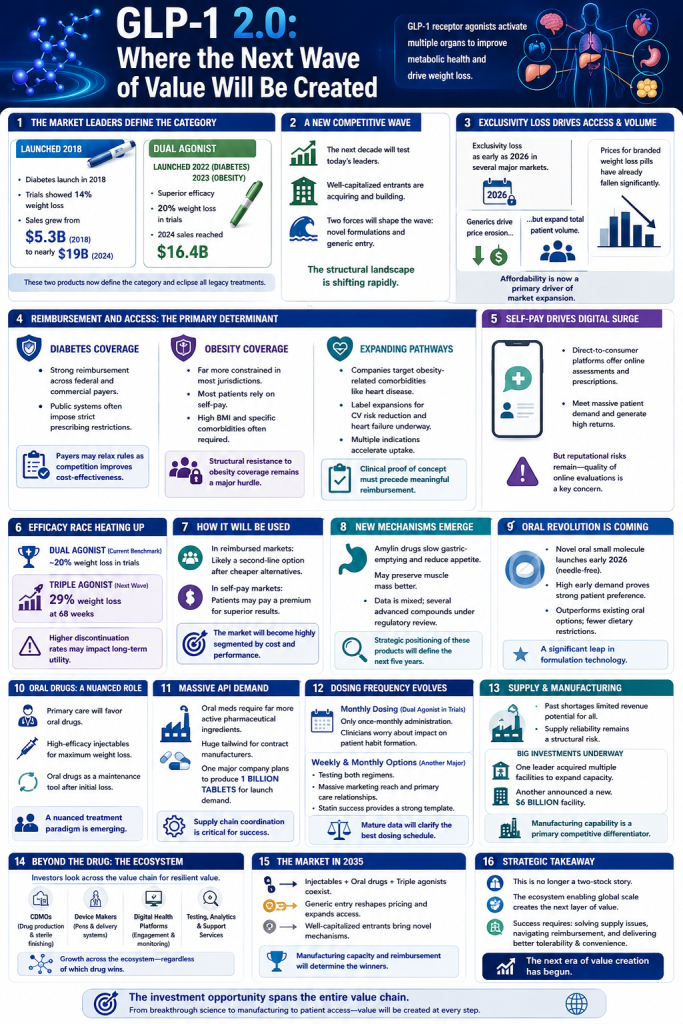
GLP-1 receptor agonists activate multiple organs to improve metabolic health and drive weight loss. A specific molecule launched for diabetes in 2018 became a phenomenon after trials showed 14 percent weight loss. Consequently, global sales for this treatment surged from 5.3 billion dollars to nearly 19 billion dollars by 2024.
Intensifying Competition, Patent Expiry, and Market Expansion in the Obesity Drug Industry
A competing dual agonist entered the market for diabetes in 2022 and obesity in 2023. This drug demonstrated superior efficacy with weight loss reaching 20 percent in clinical trials. As a result, its combined sales reached 16.4 billion dollars in 2024. These two products now define the category and eclipse all legacy treatments.
The upcoming decade will test the current market leaders despite their deep development pipelines. Well-capitalized entrants are building positions through strategic acquisitions of smaller biotech developers. Two forces will shape this competitive wave through novel formulations and generic entry. Therefore, the structural landscape of the market is shifting rapidly.
One leading molecule faces loss of exclusivity as early as 2026 in several major markets. Cheaper generics will drive price erosion but will simultaneously expand the total patient volume. Prices for branded weight loss pills have already fallen significantly due to federal pricing initiatives. Thus, affordability is becoming a primary driver of market expansion.
Evolving Reimbursement Policies and the Shift Toward a Broader Obesity Care Ecosystem
Brand premiums will persist for innovative molecules with superior efficacy or niche uses. Nevertheless, the case for generic manufacturers and contract organizations grows stronger as prices descend. Strategic investors now look toward the broader ecosystem to find sustainable value. Accordingly, the market is moving beyond a simple two-company narrative.
Insurance coverage remains the primary determinant of patient penetration over the next decade. Diabetes treatments already enjoy strong reimbursement across federal and commercial payers. However, public healthcare systems often impose strict prescribing restrictions on these medications. Payers may relax these rules as competition improves the cost-effectiveness of therapy.
Obesity coverage remains far more constrained than diabetes reimbursement in most jurisdictions. Most patients currently rely on self-pay options to access these weight loss medications. Some systems mandate a high body mass index and specific comorbidities before approving coverage. In light of this, structural resistance to obesity coverage remains a significant hurdle.
Pharmaceutical companies are targeting obesity-related comorbidities like heart disease to secure better coverage. Label expansions for cardiovascular risk reduction and heart failure are already underway. Most advanced pipeline molecules undergo simultaneous trials for multiple indications to speed up uptake. Given this, clinical proof of concept must precede meaningful commercial reimbursement.
Rise of Digital Care Platforms and the Next Wave of Obesity Drug Innovation
The persistent self-pay segment has sparked a surge in direct-to-consumer digital platforms. These sites offer online assessments and prescriptions to meet massive patient demand. While these platforms generate high returns, they also carry notable reputational risks. Specifically, concerns exist regarding the quality of online medical evaluations.
In reimbursed markets, clinicians will likely use this triple agonist as a second-line option. It will serve patients who fail to lose sufficient weight on cheaper alternatives. Patients in self-pay markets may pay a premium for its superior weight loss results. To be precise, the market will become highly segmented based on cost and performance.
Emerging amylin drugs offer a different mechanism by slowing gastric emptying and reducing appetite. These compounds may preserve muscle mass better than traditional receptor agonists. Current clinical data remains mixed, but several advanced compounds are under regulatory review. Hence, the strategic positioning of these products will define the next five years.
The most immediate market disruption will likely come from new oral formulations. A novel small molecule oral drug expects to launch in early 2026 for needle-free use. The demand for oral options is already proven by high initial prescription volumes. In view of this, patient preference is shifting toward more convenient delivery methods.
This new oral drug should outperform existing options due to its manufacturing scalability. It lacks the strict dietary restrictions that currently hinder some oral semaglutide treatments. While some competitors face tolerability issues, this molecule shows strong potential for primary care. Thus, it represents a significant leap in formulation technology.
Primary care physicians will likely favor oral drugs over complex injectable regimens. High-efficacy injectables may remain the choice for patients seeking maximum possible weight loss. Oral drugs could eventually serve as a maintenance tool after initial weight reduction. Building on this, a nuanced treatment paradigm is starting to emerge.
Oral medications require significantly more active pharmaceutical ingredients than injectable versions. This creates a massive demand tailwind for contract manufacturers with specialized expertise. One major company plans to produce one billion tablets to meet anticipated launch demand. Accordingly, supply chain coordination is now a critical factor for success.
Persistent supply constraints have limited the revenue potential of all market participants. Years of drug shortages highlighted the risks of rapid demand growth. Although current shortages are resolving, supply reliability remains a structural risk for new molecules. Consequently, companies must invest heavily in their internal production capacity.
Investors seeking lower risk often look toward the manufacturing ecosystem for exposure. Various contract development and manufacturing organizations handle drug production and sterile finishing. This includes makers of self-injection pens and specialized delivery devices. Along with this, digital health platforms capture growth regardless of which drug wins.
Conclusion
The market in 2035 will look vastly different from the current landscape. Original injectables will share the market with oral molecules and triple agonists. Generic entry will reshape pricing and expand access for millions of new patients. Furthermore, well-capitalized entrants will challenge the current duopoly with novel mechanisms.