Is Walnut Good for Weight Loss? A Clinical Review of the Evidence

Obesity remains a persistent public health concern. Clinicians frequently address questions regarding specific foods and their role in weight management. Walnuts, despite high caloric density, attract sustained research interest. Notably, several clinical trials associate regular walnut consumption with favorable weight outcomes.
This review examines the evidence linking walnut intake to weight regulation. Discussion includes appetite hormone response, macronutrient composition, and metabolic risk factors. Furthermore, the analysis addresses type 2 diabetes risk, given its close relationship with obesity. Evidence limitations receive explicit acknowledgment throughout this review.
Historically, energy dense foods were assumed to promote weight gain linearly. This assumption drove clinical caution around recommending nuts for weight management. Nevertheless, accumulating trial data challenge this simplified caloric framework. Understanding the underlying mechanisms clarifies why walnuts behave differently than other calorie dense foods.
Nutritional Composition of Walnuts and Metabolic Relevance
Macronutrient Profile and Caloric Density
A single ounce of walnuts provides close to 185 calories. This caloric density exceeds many whole foods recommended for weight loss. Consequently, walnuts often raise concern among individuals pursuing caloric restriction. However, caloric density alone does not predict weight outcomes.
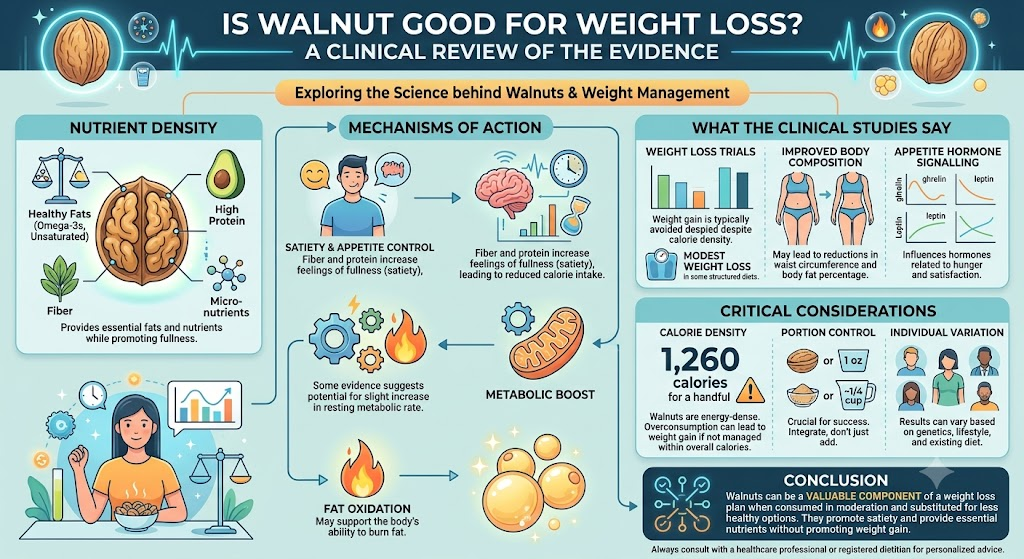
Walnuts contain substantial quantities of protein, fiber, and unsaturated fat. This combination promotes gastric distension and delayed gastric emptying. As a result, individuals experience prolonged satiety after consumption. Fiber content also reduces net energy absorption from the total caloric load.
Polyunsaturated Fatty Acid Content
Walnuts contain a high concentration of polyunsaturated fatty acids, particularly alpha linolenic acid. This omega three fatty acid supports favorable lipid metabolism. Moreover, polyunsaturated fats influence thermogenesis differently than saturated fats. Emerging evidence suggests this metabolic distinction supports modest increases in energy expenditure.
Compared with monounsaturated fats, alpha linolenic acid follows a distinct metabolic pathway. This pathway favors oxidation over storage under typical dietary conditions. Consequently, a meaningful proportion of walnut fat calories does not translate directly into adipose accumulation. This distinction partly explains the discrepancy between predicted and observed weight outcomes.
Micronutrient and Fiber Contributions
Beyond fat and protein, walnuts supply magnesium, copper, and manganese in meaningful amounts. These micronutrients support enzymatic processes involved in glucose and lipid metabolism. In addition, walnuts contain approximately two grams of dietary fiber per ounce. Fiber intake supports gastrointestinal transit and contributes to sustained satiety.
Adequate magnesium status aligns with improved insulin sensitivity in observational research. Given this association, walnut derived magnesium offers secondary metabolic benefits. However, current evidence does not establish a direct causal pathway to weight loss. Micronutrient contributions should therefore be considered supportive rather than primary mechanisms.
Mechanisms Linking Walnut intake to Appetite Regulation
Satiety Hormone Response
Postprandial satiety involves coordinated hormonal signaling between the gut and brain. Walnut consumption aligns with early satiety responses in clinical studies. To be precise, walnut containing meals produce cholecystokinin and peptide YY responses comparable to nut free control meals. These hormones signal fullness directly to the central nervous system.
Notably, walnut meals attenuate postprandial insulin and glucagon like peptide responses. This attenuation reflects slower carbohydrate absorption from the meal matrix. Consequently, blood glucose fluctuations remain more stable following walnut consumption. Stable glucose levels reduce subsequent hunger signaling.
Neural Reward Pathway Modulation
Walnut consumption also influences neural responses to food related cues. Functional imaging studies demonstrate altered insula activation following walnut intake. The insula processes interoceptive signals related to hunger and reward. Given this, walnut consumption reduces reward driven eating behavior.
This neural modulation appears within days of regular walnut intake in trial settings. Reduced activation toward high calorie food cues suggests a shift in reward valuation. Meanwhile, self reported hunger and craving scores decrease during walnut supplementation periods. These behavioral findings align with observed hormonal and imaging based mechanisms.
Gastrointestinal Absorption and Caloric Bioavailability
Walnut structure limits the caloric bioavailability of the food itself. Intact cell wall matrices trap a portion of lipid content during digestion. As a result, a fraction of ingested fat exits the body unabsorbed. This structural property further reduces net caloric impact beyond satiety effects alone.
Fecal fat excretion studies confirm reduced energy extraction following walnut consumption compared with predicted values. This finding partly explains why observed weight outcomes exceed caloric predictions based on nutrition labels. Therefore, standard caloric counting overestimates the true metabolic burden of walnut consumption. Clinicians should consider this distinction when counseling individuals on portion sizes.
Clinical Trial Evidence on Walnut Consumption and Body Weight
Weight Reduction Interventions
Randomized controlled trials provide the strongest evidence for walnut effects on body weight. One trial compared a walnut enriched diet against a standard lower fat diet. Weight loss outcomes proved comparable between the two dietary approaches. Importantly, the walnut group did not experience unexpected weight gain despite higher fat intake.
A separate randomized trial evaluated regular walnut consumption without caloric restriction. Body weight and body mass index remained stable throughout the intervention period. Likewise, waist circumference did not increase significantly among participants. These findings challenge assumptions that energy dense foods inherently promote weight gain.
Long Term Supplementation Studies
Longer duration studies extend these findings beyond short term interventions. A trial examining older participants found no significant weight increase after extended walnut supplementation. Similarly, a meta-analysis of multiple randomized trials found no adiposity increase associated with nut enriched diets. Indeed, nut inclusion produced greater weight loss than low fat diets alone.
These results support incorporating walnuts into structured weight management programs. Portion control remains essential, since excessive intake offsets caloric benefits. Therefore, clinicians should recommend standardized serving sizes, such as one ounce daily. Building on this, standardized portions balance potential benefits against caloric contribution.
Comparative Outcomes Against Other Dietary Fat Sources
Several trials directly compared walnut enriched diets with diets rich in other fat sources. Outcomes generally favor walnuts for both weight stability and lipid improvement. Similarly, comparisons with refined carbohydrate snacks show favorable results for walnut substitution. Participants replacing refined snacks with walnuts reported greater satiety and modest weight reduction.
These comparative findings suggest that food substitution matters more than caloric counting alone. Replacing lower quality snack options with walnuts appears more effective than simple caloric restriction. Indeed, dietary pattern quality influences weight outcomes independent of total energy intake. Thus, this principle supports broader dietary quality focused counseling approaches.
Walnuts and Metabolic Risk Factors Relevant to Weight Management
Type 2 diabetes risk
Obesity and type 2 diabetes share overlapping metabolic pathways. Walnut consumption aligns with reduced diabetes incidence in epidemiological studies. Improved insulin sensitivity likely contributes to this protective association. Additionally, reduced postprandial glucose excursions lower long term diabetes risk.
Lipid profile improvements
Walnut consumption consistently improves lipid profiles across clinical trials. Total cholesterol and low density lipoprotein cholesterol decrease with regular intake. This lipid improvement occurs independent of significant weight change. Beyond this, favorable lipid shifts reduce cardiovascular risk among individuals pursuing weight management.
Cardiovascular Risk Considerations
Obesity and cardiovascular disease share numerous overlapping risk pathways. Walnut consumption connects to reduced cardiovascular event rates in cohort studies. This protective association reflects combined lipid, inflammatory, and vascular benefits. Authoritative national bodies recognize qualified health claims regarding walnuts and heart disease.
Regular walnut intake also aligns with modest reductions in blood pressure in select trials. Lower blood pressure further supports overall cardiometabolic health during weight management efforts. Nevertheless, these cardiovascular benefits should be viewed as complementary to weight outcomes. They do not replace standard cardiovascular risk reduction strategies.
Clinical considerations and limitations of current evidence
Current evidence demonstrates association rather than definitive causation in several studies. Study populations often exclude individuals with significant comorbidities, limiting generalizability. Nevertheless, consistent findings across multiple trial designs strengthen confidence in observed effects. Clinicians should interpret these findings as supportive rather than singularly therapeutic.
Walnut consumption should complement, rather than replace, comprehensive weight management strategies. Effective approaches integrate dietary modification, physical activity, and behavioral support. Weight management protocols should account for individual caloric requirements and existing comorbidities. In light of this, walnuts represent one component within broader nutritional planning.
Trial durations across existing literature vary considerably, ranging from single meal studies to multiyear interventions. Shorter trials cannot fully capture long term adherence or sustained metabolic adaptation. Additionally, most trial populations reflect predominantly healthy or overweight adults rather than individuals with severe obesity. Extrapolation to broader clinical populations therefore warrants appropriate caution.
Allergy status warrants consideration before recommending walnut incorporation into any dietary plan. Tree nut allergy remains a contraindication regardless of potential metabolic benefits. Clinicians should screen for allergy history prior to recommending walnut based interventions. Hence, this screening step remains fundamental to safe clinical guidance.
Conclusion
Available evidence indicates that walnut consumption does not promote unwanted weight gain. Multiple mechanisms, including satiety hormone modulation and neural reward regulation, support this observation. Clinical trials further demonstrate comparable or superior weight outcomes relative to walnut free diets. Accordingly, walnuts merit consideration within evidence based weight management recommendations.
Future research should clarify optimal serving sizes and long term adherence patterns. Additional trials focusing on diverse populations would strengthen current conclusions. As research accumulates, walnuts may gain broader recognition within clinical nutrition guidance for weight management.
References
Rock, C. L., Flatt, S. W., Barkai, H. S., Pakiz, B., & Heath, D. D. (2017). Walnut consumption in a weight reduction intervention: Effects on body weight, biological measures, blood pressure and satiety. Nutrition Journal, 16(1), 76. https://doi.org/10.1186/s12937-017-0304-z
Sabaté, J., Cordero-MacIntyre, Z., Siapco, G., Torabian, S., & Haddad, E. (2005). Does regular walnut consumption lead to weight gain? British Journal of Nutrition, 94(5), 859-864. https://doi.org/10.1079/BJN20051567
Torabian, S., Haddad, E., Rajaram, S., Banta, J., & Sabaté, J. (2009). Acute effect of nut consumption on plasma total polyphenols, antioxidant capacity and lipid peroxidation. Journal of Human Nutrition and Dietetics, 22(1), 64-71. https://doi.org/10.1111/j.1365-277X.2008.00923.x