13 Science-Backed Ways GLP-1 Medications May Benefit the Body

Doctors now use GLP-1 drugs to change how they treat the human body. These medicines first helped people manage high blood sugar levels effectively. Now, drugs like Ozempic and Mounjaro help people lose weight safely. Scientists continue to find new ways these drugs help our organs.
Research shows that these medications do more than just stop hunger. They work with the brain and the heart in very special ways. This helps doctors treat many health problems at the same time. Therefore, these treatments offer hope for a much healthier future.
Mechanisms Underlying GLP-1 Receptor Agonist Activity
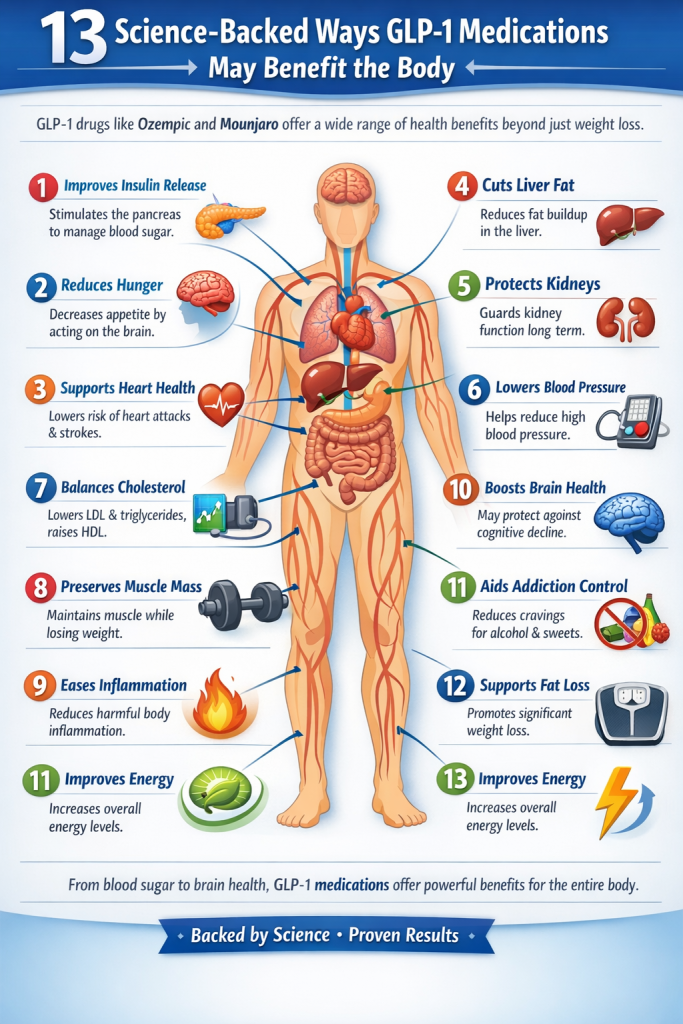
GLP-1 drugs tell the pancreas to release insulin when sugar is high. This helps keep blood sugar levels in a very safe range. Because of this, patients have a lower risk of sudden sugar drops. This makes the treatment safer than many older diabetes pills.
These drugs also stop the liver from making too much extra sugar. This leads to much flatter sugar levels after a person eats. Patients often feel more stable throughout the day as a result. Maintaining steady energy is a huge win for most people.
The brain has special spots that control how hungry we feel. GLP-1 drugs target these exact areas to turn off hunger signals. This makes people feel full much faster than they did before. Consequently, eating smaller portions becomes a much easier task to handle.
Wegovy is a popular version used specifically for long-term weight loss. It uses a high dose to send strong signals to the brain. People lose weight because their body chemistry changes, not just willpower. Thus, the medicine helps the mind and body work together.
These medications slow down how fast food leaves the stomach. This keeps food in the system for a longer time. Because food moves slowly, people feel satisfied for many hours. In light of this, snacking between meals happens much less often.
Slower digestion also prevents big spikes in blood sugar after lunch. The body gets a steady stream of energy instead of a rush. This helps the heart and the metabolism stay very healthy. Along with this, weight loss becomes much more manageable.
| System / Organ | Benefit of GLP-1 Medications | Clinical Observation |
| Pancreas | Enhanced Glycemic Control | Stimulates insulin when needed and stops extra sugar release. |
| Brain | Appetite Suppression | Makes the brain feel full and reduces cravings for food. |
| Cardiovascular | Risk Reduction | Helps prevent heart attacks and lowers high blood pressure. |
| Liver | Hepatic Fat Reduction | Cleans out extra fat that builds up inside the liver. |
| Kidneys | Renal Protection | Stops damage to the filters inside the kidneys over time. |
| Metabolic | Lipid Improvement | Lowers bad fats like triglycerides and raises good cholesterol. |
| Musculoskeletal | Muscle Preservation | Helps keep muscles strong while the body loses extra fat. |
Cardiometabolic and Systemic Benefits
Major studies prove these drugs protect the heart from serious damage. People taking them have fewer heart attacks and fewer strokes. These benefits happen even if their blood sugar is already okay. Hence, the heart gets stronger just by using the medicine.
Scientists believe the drugs reduce swelling and irritation in the arteries. They also help the body handle fats in a better way. Many heart doctors now suggest these drugs to their patients. Accordingly, these tools are vital for living a longer life.
Patients often see their blood pressure numbers drop while on GLP-1s. The medicine helps the blood vessels relax and stay wide open. This lets blood flow through the body with much less effort. Notably, this takes a lot of stress off the heart.
Losing weight also helps the blood pressure stay in a healthy zone. These two effects work together to keep the body very safe. Better blood pressure means a much lower risk of future problems. Therefore, the body stays younger and stronger for longer.
GLP-1 drugs help lower the bad fats found in the blood. They specifically target triglycerides which can clog up the heart’s pipes. This helps the liver process energy in a much cleaner way. Building on this, good cholesterol often goes up.
People with high cholesterol see a big difference with these agents. This makes the drugs a great choice for heart health. They fit perfectly into a plan to stay healthy overall. Thus, they protect the body from several different angles.
Fatty liver disease is a growing problem for many adults today. This happens when too much fat builds up inside the liver. GLP-1 drugs help the liver burn off this extra fat. As a result, the liver can do its job better.
New data shows that these drugs also reduce liver scarring. This is very important for preventing long-term liver failure in patients. Doctors are testing semaglutide right now to see how it helps. Future results will likely show even more positive liver changes.
Renal, Inflammatory, and Neurological Effects
The kidneys act as the body’s filters and need extra protection. GLP-1 drugs stop these filters from working too hard every day. They also reduce the swelling that causes kidney disease to worsen. Meanwhile, losing weight takes the physical pressure off the kidneys.
Kidney specialists are now using these drugs more often for patients. They see fewer signs of protein leaking into the urine. This is a great sign that the kidneys are staying healthy. Consequently, patients may avoid needing dialysis later in their lives.
Body fat can cause a lot of hidden swelling and pain. GLP-1 drugs work to lower these signs of irritation throughout. They lower specific chemicals in the blood that cause health issues. Thus, the whole body feels much better and works smoother.
The drug works by fixing the fat cells and the brain. This double action makes it very powerful for reducing body stress. Fewer flare-ups lead to a much higher quality of life. Accordingly, people feel more active and have more energy.
The brain also has receptors for these helpful GLP-1 signals. Some research suggests the drugs might protect the brain from aging. They may even stop bad proteins from building up over time. Notably, this could help people with memory loss or shaking.
Some early studies show the drugs might slow down Parkinson’s disease. Patients in these groups seem to move better and feel sharper. Scientists are currently doing more tests to be sure of this. Results could change how we treat brain diseases forever.
The brain has a reward system that makes us want things. This system controls why people want alcohol or too much sugar. GLP-1 drugs seem to quiet these loud cravings in the mind. Given this, people find it much easier to say no.
Early stories show people drinking much less alcohol while on these. This area is still being studied by many top researchers today. It might become a new way to help with addiction issues. Nevertheless, we need more time to prove these effects fully.
Weight Management Outcomes in Obesity
Clinical trials show that these drugs beat diet and exercise alone. Patients using Mounjaro often lose a huge amount of body weight. This is a major breakthrough for people who have struggled. Therefore, science is finally providing a tool that really works.
One study showed people losing 15 percent of their total weight. This happened over about one year of taking the medication. Some people even lost much more than that on higher doses. These figures are much better than older weight loss pills.
When people diet, they often lose muscle instead of just fat. GLP-1 drugs help the body hold onto its important muscle. This is vital for staying strong and keeping the metabolism high. Furthermore, lifting weights while on the drug helps even more.
Keeping muscle is what makes these drugs different from a fast. It ensures that the weight loss is mostly the bad fat. This keeps the body looking and feeling much more athletic. Thus, the heart and muscles stay in great shape.
Conclusion
GLP-1 drugs offer many benefits that go far beyond weight. They help the heart, the liver, and the kidneys stay healthy. Science shows they even protect the brain and reduce body swelling. Moreover, they give people a real chance to change their lives.
The future of these medications looks very bright for everyone. Doctors are finding new uses for them almost every single year. These tools help treat many of the world’s biggest health problems. Consequently, more people are living longer and healthier lives now.
Clinicians have a powerful new way to help their patients. These medicines are safe and work well for most people today. The safety and results continue to get better with more research. Hence, the way we treat the body has changed forever.
References
Husain, M., Birkenfeld, A. L., Donsmark, M., Dungan, K., Eliaschewitz, F. G., Franco, D. R., Jeppesen, O. K., Lingvay, I., Mosenzon, O., Pedersen, S. D., Tack, C. J., Thomsen, M., Vilsboll, T., Warren, M. L., & Bain, S. C. (2020). Oral semaglutide and cardiovascular outcomes in patients with type 2 diabetes. New England Journal of Medicine, 381(9), 841–851. https://doi.org/10.1056/NEJMoa1901118
Jastreboff, A. M., Aronne, L. J., Ahmad, N. N., Wharton, S., Connery, L., Alves, B., Kiyosue, A., Zhang, S., Liu, B., Bunck, M. C., & Stefanski, A. (2022). Tirzepatide once weekly for the treatment of obesity. New England Journal of Medicine, 387(3), 205–216. https://doi.org/10.1056/NEJMoa2206038
Wilding, J. P. H., Batterham, R. L., Calanna, S., Davies, M., Van Gaal, L. F., Lingvay, I., McGowan, B. M., Rosenstock, J., Tran, M. T. D., Wadden, T. A., Wharton, S., Yokote, K., Zeuthen, N., & Kushner, R. F. (2021). Once-weekly semaglutide in adults with overweight or obesity. New England Journal of Medicine, 384(11), 989–1002. https://doi.org/10.1056/NEJMoa2032183
Marso, S. P., Daniels, G. H., Brown-Frandsen, K., Kristensen, P., Mann, J. F. E., Nauck, M. A., Nissen, S. E., Pocock, S., Poulter, N. R., Ravn, L. S., Steinberg, W. M., Stockner, M., Zinman, B., Bergenstal, R. M., & Buse, J. B. (2016). Liraglutide and cardiovascular outcomes in type 2 diabetes. New England Journal of Medicine, 375(4), 311–322. https://doi.org/10.1056/NEJMoa1603827
Marso, S. P., Daniels, G. H., Brown-Frandsen, K., Kristensen, P., Mann, J. F. E., Nauck, M. A., Nissen, S. E., Pocock, S., Poulter, N. R., Ravn, L. S., Steinberg, W. M., Stockner, M., Zinman, B., Bergenstal, R. M., & Buse, J. B. (2016). Liraglutide and cardiovascular outcomes in type 2 diabetes. New England Journal of Medicine, 375(4), 311–322. https://doi.org/10.1056/NEJMoa1603827