Intuitive Eating Explained: Learning to Trust Your Body’s Signals

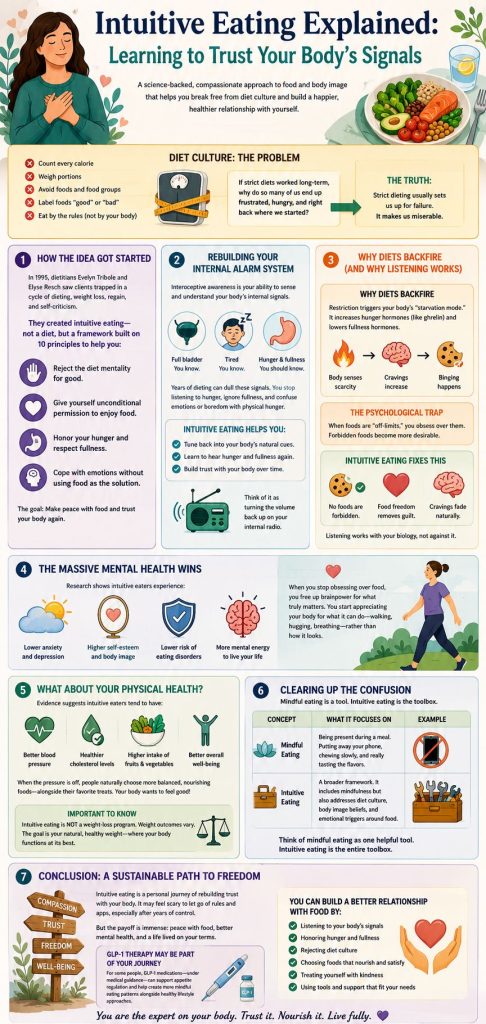
Let’s be completely honest: diet culture is absolutely everywhere. For decades, society has told us that getting healthy means following strict, exhausting rules. We are taught to count every single calorie, weigh our portions on tiny digital scales, and avoid eating after 7 PM. We cut out carbs, track our macros, and label foods as “good” or “bad.”
But think about it: if these rigid diets actually worked for the long haul, why do so many of us end up frustrated, incredibly hungry, and right back where we started?
The simple truth is that strict dieting usually sets us up for failure. It makes us miserable. Enter intuitive eating, a completely different approach that throws the traditional rulebook out the window. Instead of looking outward at meal plans and fitness apps, it asks you to do something that feels quite radical: look inward and actually listen to your own body.
How the Idea Got Started
Back in 1995, two registered dietitians, Evelyn Tribole and Elyse Resch, noticed a heartbreaking trend in their practices. Their clients were completely burned out. They were stuck in a painful, endless cycle of losing weight, gaining it back, and feeling like failures.
To help them break out of this trap, Tribole and Resch created the intuitive eating framework. Unlike keto, paleo, or whatever the latest social media fad happens to be, intuitive eating isn’t a diet at all. It doesn’t hand you a list of approved foods or tell you when you are allowed to eat. Instead, it is built on ten core principles designed to help you:
- Reject the diet mentality for good.
- Give yourself unconditional permission to enjoy food.
- Recognize when you are genuinely hungry and when you are comfortably full.
- Cope with hard emotions like stress or sadness without automatically reaching for comfort food.
Rebuilding Your Internal Alarm System
To really understand how this works, we need to talk about interoceptive awareness. It sounds like complicated science jargon, but it simply means your ability to perceive and understand the physical signals your body sends to your brain.
Think about your daily life. When you have a full bladder, you just know you need to use the restroom. When you haven’t slept, your eyes feel heavy, and you know you’re tired. Hunger and fullness are supposed to work the exact same way.
Unfortunately, years of strict dieting can actually break this internal alarm system. If you spend years ignoring your rumbling stomach because it’s “not time to eat yet,” or forcing yourself to eat a huge breakfast when you aren’t hungry because an article told you to, you eventually stop feeling those natural cues. You might even start confusing anxiety or sheer boredom with physical hunger.
Intuitive eating is all about tuning back into that internal radio station. It takes time, especially if you are used to ignoring your body, but you can absolutely learn to hear those natural signals again.
Why Diets Backfire (And Why Listening Works)
When you severely restrict what you eat, your body panics. It doesn’t know you are just trying to slim down for summer vacation; biologically, it genuinely thinks you are starving. So, your body decides to fight back.
It ramps up the production of hormones that make you hungry (like ghrelin) and lowers the hormones that tell your brain you are full. This is exactly why you end up with intense cravings for high-energy, sugary foods and eventually end up overeating or bingeing on them.
On top of the biology, there is a psychological trap. Making certain foods “off-limits” just makes you obsess over them. If someone tells you that you can never have chocolate again, chocolate is suddenly the only thing you can think about. Intuitive eating fixes this by removing the guilt. When no food is forbidden, and you know you can have a cookie whenever you actually want one, the intense, frantic urge to overeat starts to naturally fade away.
The Massive Mental Health Wins
The benefits of ditching the diet cycle are huge, especially for your mental well-being. Study after study shows that people who practice intuitive eating generally experience:
- Lower levels of everyday anxiety and depression.
- Much higher self-esteem and better body image.
- A significantly lower risk of developing dangerous eating disorders.
When you stop agonizing over every single bite of food you put in your mouth, you free up an unbelievable amount of mental energy. You can use that brainpower for your hobbies, your family, or your career. You also start to appreciate your body for what it can do like walking, hugging, and breathing rather than hating it for how it looks in the mirror.
What About Your Physical Health?
Now, a lot of people wonder, “If I let myself eat whatever I want, won’t my health totally fall apart?” Actually, the scientific evidence suggests the exact opposite.
Research shows that intuitive eaters tend to have better blood pressure and healthier cholesterol levels. Interestingly, they also tend to eat more fruits and vegetables than chronic dieters naturally. Once the heavy pressure is off, people usually start craving balanced, nourishing meals alongside their favorite treats. Your body actually wants to feel good, and eating nothing but cake doesn’t feel good after a while.
Here is the catch, though: intuitive eating is not a secret weight-loss program. While some people might lose weight when they stop bingeing, others might maintain their current weight, or even gain a little bit as their body recovers from years of restriction. The goal is simply finding the natural, healthy weight where your specific body functions at its absolute best.
Clearing Up the Confusion
People often mix up intuitive eating with mindful eating, but they aren’t quite the same thing.
| Concept | What It Focuses On |
| Mindful Eating | Being present during a meal. Putting away your phone, chewing slowly, and really tasting the flavors. |
| Intuitive Eating | A broader framework. It includes mindfulness but also tackles diet culture, challenges deep-seated beliefs about body image, and untangles emotional triggers around food. |
Think of mindful eating as a single helpful tool, while intuitive eating is the entire toolbox.
Conclusion
Ultimately, intuitive eating offers a peaceful, sustainable way out of the exhausting diet cycle. It is a deeply personal journey of rebuilding broken trust with yourself.
For some people exploring weight management options, GLP-1 medications may also play a role alongside healthy lifestyle approaches. Under medical guidance, these therapies can support appetite regulation and help create more mindful eating patterns.
It might feel really scary at first to let go of your calorie-counting apps and food rules, especially if you have relied on them for years to feel in control. But the payoff can be immense. By treating yourself with compassion, listening to your body’s needs, and understanding how tools like GLP-1 therapy may fit into your overall health journey, you can build a balanced, joyful relationship with food that supports long-term well-being.