Getting Your Sense of Taste Back on GLP-1 Meds

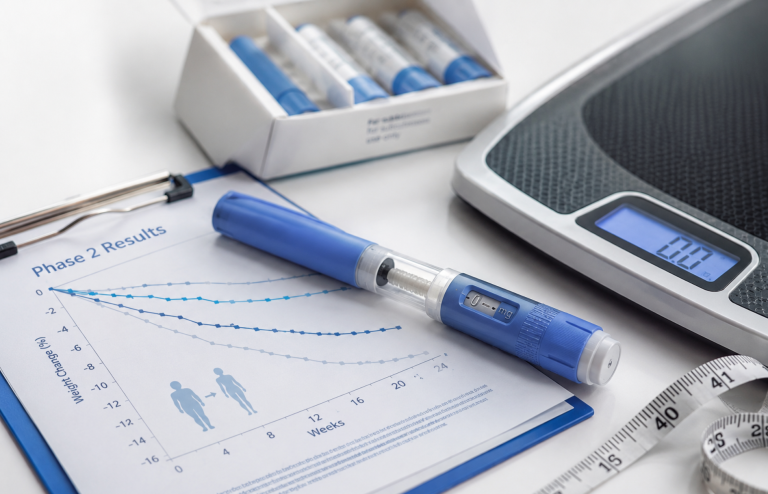
GLP-1 medications like Ozempic, Wegovy, and Mounjaro have completely changed how we treat obesity and type 2 diabetes. Millions of people are now taking them. But along with less hunger and better blood sugar, many patients are noticing a strange side effect: food just doesn’t taste the same anymore. Meals can taste bland, metallic, or just plain unappealing.
Doctors are now taking this seriously rather than just brushing it off. When food stops tasting good, people stop eating the healthy foods they need most. The good news is that once you understand why this happens, a few simple kitchen tricks like leaning into herbs and spices can bring the flavor right back.
Why Do These Medications Change How Food Tastes?
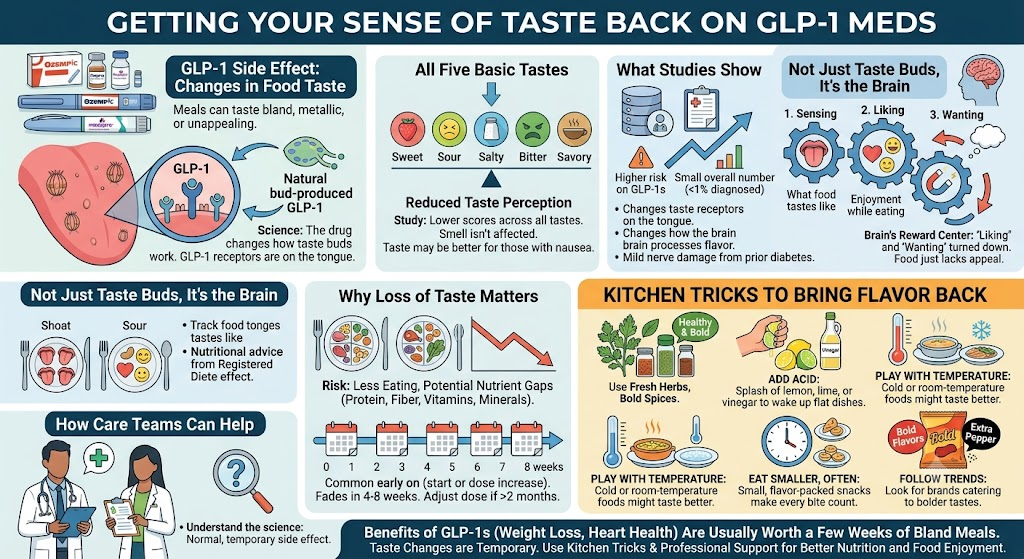
It turns out GLP-1 isn’t just a hormone in your gut. Your taste buds actually make a little bit of it too, and the nerves in your tongue have receptors for it. This local connection helps your brain figure out how sweet something is. When a medication activates these receptors all over your body, it can change how your taste buds work at the source.
A recent study proved this by testing people taking these medications. Compared to people not on the drugs, those taking GLP-1s scored lower across all five basic tastes: sweet, sour, salty, bitter, and savory.
Interestingly, the smell wasn’t really affected. And strangely enough, people who had stomach side effects like nausea actually did better on the taste tests. This shows the science is complicated, and the drug affects everyone a bit differently.
What the Big Studies Show
When researchers looked at large databases of patient records, they found the same trend. People on GLP-1s were more likely to report new taste issues than patients taking other types of diabetes drugs.
However, the actual numbers are still very small. Less than 1% of patients ever get an official diagnosis for a taste disorder. For the vast majority of people, it’s a minor annoyance rather than a medical crisis.
Scientists think a few things are happening at once:
- The medication changes the taste receptors on the tongue.
- The drug changes how the brain processes flavor signals.
- For people with diabetes, mild nerve damage might already be affecting their taste before they even start the medicine.
It’s Not Just Your Taste Buds It’s Your Brain
Some researchers point out that losing your taste isn’t the whole story. It helps to break the food experience down into three parts:
- Sensing: What the food actually tastes like on your tongue.
- Liking: How much you enjoy it while eating.
- Wanting: How much you crave it beforehand.
When someone says, “Food just doesn’t appeal to me anymore,” their taste buds might actually be working perfectly. Instead, what has changed is their craving for the reward center in the brain is turned down. Knowing the difference helps doctors give much better advice.
Why Loss of Taste Matters for Your Health
When food tastes bad, you eat less. If you are already eating tiny portions because the drug suppresses your appetite, this can become a real problem. You might miss out on vital protein, fiber, vitamins, and minerals.
On drug labels, taste changes are listed as an uncommon side effect, mostly tied to the pill forms of the medication. It usually happens early on either when you first start or when your dose goes up. For most people, the problem fades within four to eight weeks as the body adjusts.
If it lasts longer than two months, it’s time to talk to your doctor. Sometimes, slightly adjusting your dose can protect your nutrition while keeping the medication working.
Kitchen Tricks to Bring Flavor Back
One of the easiest ways to fix bland food is to crank up the flavor using healthy ingredients like fresh herbs, bold spices, lemon juice, or vinegar. This adds a punch of flavor without loading your food with extra sugar or salt.
This isn’t just guesswork; it’s backed by science. A recent nutrition study tested foods that were reformulated to have much less salt. To make up for it, chefs loaded them with herbs and spices. In blind taste tests, people rated the low-salt, highly-seasoned food just as highly as the original, salty versions. Good seasoning can absolutely rescue a bland meal.
Quick Tips for More Flavorful Meals:
- Add Acid: A splash of lime, lemon, or red wine vinegar can wake up a flat dish.
- Play with Temperature: Some people find that cold or room-temperature foods taste much better than steaming hot meals when on these meds.
- Eat Smaller, Often: Since your appetite is low, eat small, flavor-packed snacks throughout the day so every bite counts.
- Follow the Food Trends: Even major food companies have noticed this side effect! Some brands are now making products with bolder spices and extra pepper specifically for people on GLP-1 medications.
How Care Teams Can Help
Doctors and dietitians can support patients by simply asking, “How is your food tasting?” tracking this at every visit especially during dose changes helps catch nutritional gaps early.
Having a registered dietitian on your care team makes a massive difference. Instead of just telling you to “hang in there,” a dietitian can give you real, practical meal ideas.
It also helps to just understand the science. When patients realize that taste changes are a normal, temporary biological side effect and not a sign that something is wrong with them, they feel a lot better about staying on their treatment.
Conclusion
For most people, the massive health benefits of GLP-1 medications like weight loss and heart health are well worth a few weeks of bland meals.
Taste changes are real, but they are usually temporary. By using smart kitchen tricks, leaning on fresh herbs and spices, and working closely with your doctor or dietitian, you can keep your nutrition on track and enjoy your food again.
References
Altered eating experience during GLP-1 receptor agonist therapy: A sensory-liking-wanting framework for food preference and nutritional behaviour. (2026). Frontiers in Nutrition. https://doi.org/10.3389/fnut.2026.1870484
Jensterle, M., Ferjan, S., Battelino, T., Kovač, J., Battelino, S., Šuput, D., Vovk, A., & Janež, A. (2021). Does intervention with GLP-1 receptor agonist semaglutide modulate perception of sweet taste in women with obesity: Study protocol of a randomized, single-blinded, placebo-controlled clinical trial. Trials, 22, 480. https://doi.org/10.1186/s13063-021-05442-y
Petersen, K. S., Fulgoni, V. L., Hopfer, H., Hayes, J. E., Gooding, R., & Kris-Etherton, P. (2024). Using herbs/spices to enhance the flavor of commonly consumed foods reformulated to be lower in overconsumed dietary components: A National Health and Nutrition Examination Survey analysis and blind tasting. Journal of the Academy of Nutrition and Dietetics, 124(1), 15-27. https://doi.org/10.1016/j.jand.2023.07.025
Zontag, J., & Zontag, N. (2026). Smell and taste disturbances among glucagon-like peptide-1 receptor agonist users. JAMA Otolaryngology–Head & Neck Surgery. Advance online publication. https://doi.org/10.1001/jamaoto.2026.1498