Can GLP-1 Drugs Help Reduce Addiction Cravings and Support Recovery?

Glucagon-like peptide-1 receptor agonists occupy an established position in medical practice. These agents primarily treat type 2 diabetes and obesity. To be precise, medications in this class include semaglutide and tirzepatide. Emerging evidence suggests these drugs affect reward-related brain circuits.
In light of this, researchers now examine their utility in addiction medicine. This inquiry addresses alcohol, nicotine, and opioid dependence. Furthermore, clinical urgency drives this scientific investigation. The scale of the problem remains substantial.
Notably, national health agencies report high mortality rates from drug overdoses. Alcohol use contributes to numerous annual deaths. Therefore, mechanistically novel candidates warrant rigorous evaluation. Nevertheless, formal regulatory approval for addiction remains pending.
Neurobiological Mechanisms Underlying Craving Attenuation
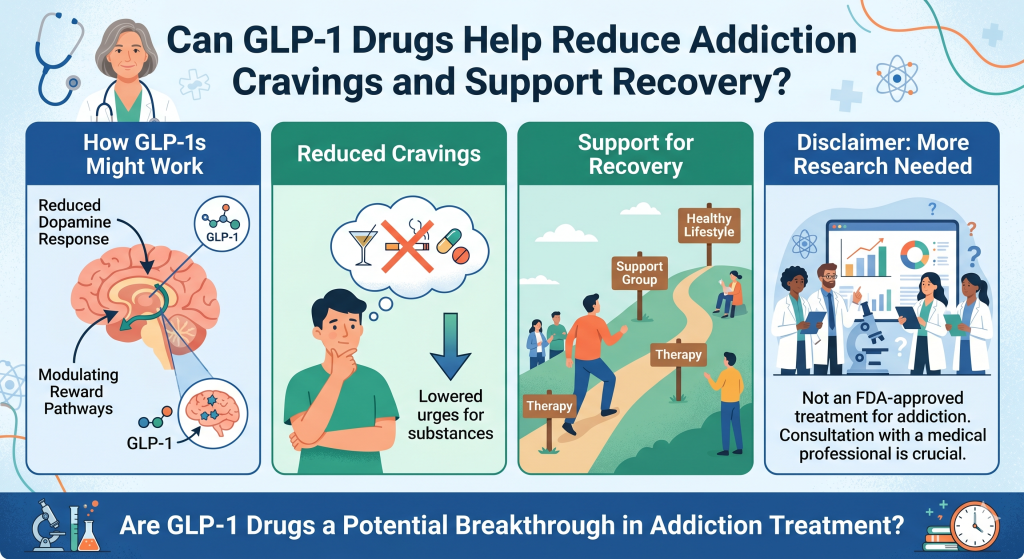
Specific receptors reside in addiction-relevant brain regions. These include the ventral tegmental area and prefrontal cortex. Along with this, these structures regulate dopamine signaling and motivational drive. They also manage to reward salience.
Activation of these receptors modulates essential neurotransmission. This process involves dopaminergic and glutamatergic pathways. Consequently, the net effect reduces reward-seeking behavior. Moreover, it diminishes the salience of environmental cues.
Certain agents also modulate GABA release in the amygdala. This action suppresses impulsive responding. Building on this, dual agonists may further reinforce executive control. Thus, studies demonstrate reduced dopamine release.
Meanwhile, vagal signaling pathways contribute to these central effects. The brainstem serves as a critical relay station. Given this, the system integrates metabolic and reward processing. Accordingly, these drugs offer a sophisticated therapeutic approach.
Primary Evidence in Alcohol Recovery
Clinical evidence for alcohol use disorder appears robust. For instance, a 2025 trial assigned participants to receive semaglutide. Treated individuals reported significantly fewer alcohol cravings. As a result, they consumed fewer drinks on average.
Supervised laboratory sessions provided objective corroboration of these findings. Participants consistently showed reduced consumption levels. Hence, this data supports the efficacy of the treatment. Therefore, the results offer promise for future care.
Furthermore, recent studies indicate lower relapse risks for these patients. One analysis found a 50 percent reduction in deaths. Notably, this cohort showed lower rates of hospitalization. These findings appear in prominent medical journals.
Progress in Tobacco and Nicotine Cessation
Preliminary data indicates these agents reduce nicotine intake. Animal models show attenuated withdrawal behaviors. In view of this, a 2024 review synthesized evidence from multiple databases. Nevertheless, clinical trial data in humans remains limited.
Specifically, preliminary efficacy signals exist for several specific agents. These include semaglutide and exenatide. However, current evidence does not support definitive conclusions. Accordingly, further clinical investigation is necessary.
Researchers seek to translate animal findings to human populations. This transition requires carefully designed studies. Building on this, the field awaits more data. Thus, the potential for smoking cessation remains high.
Observations on Opioid and Stimulant Disorders
Evidence for opioid and stimulant disorders remains primarily preclinical. One systematic review included forty-one relevant studies. Moreover, most investigations utilized animal models. Given this, translational conclusions remain somewhat limited.
The effects link to receptor activation in the nucleus accumbens. This process targets cue-induced drug seeking. Nevertheless, clinical investigations numbered only six. Therefore, the evidence base requires expansion.
Notably, study design heterogeneity affects the strength of the evidence. Smaller sample sizes often restrict broad generalizations. Along with this, professional researchers emphasize the need for larger trials. Thus, the field requires more definitive data.
Safety Profile and Off Label Clinical Use
Established safety profiles inform the potential use of these drugs. Most agents demonstrate generally acceptable adverse event profiles. In light of this, gastrointestinal symptoms represent the most frequent reports. These include nausea and appetite reduction.
Furthermore, these properties may benefit patients with comorbid conditions. Individuals with obesity often experience concurrent substance disorders. Clinicians now increasingly administer these medications off-label. Meanwhile, formal regulatory approval is still developing.
National federal agencies have not approved these specific indications. Off-label use occurs without standardized dosing guidance. Consequently, this practice lacks established prescribing parameters. Therefore, clinicians must exercise professional judgment.
Implications for Clinical Practice and Research Priorities
The convergence of mechanistic plausibility and clinical signals is vital. Current treatments for addiction demonstrate modest real-world efficacy. Along with this, many effective therapies remain significantly underutilized. No approved pharmacotherapy exists for stimulant disorders.
Given this, the identification of shared neurobiological targets is significant. This approach addresses multiple drug classes simultaneously. Nevertheless, the evidence base requires substantive expansion. Accordingly, integration into formal guidelines remains distant.
Furthermore, randomized controlled trials must include adequate sample sizes. Extended follow-up periods will ensure long-term safety. Building on this, researchers prioritize dosing optimization. Thus, several institutional groups have initiated these trials.
Moreover, clinical investigations must evaluate demographic variables. Patient response likely varies based on genetic factors. Future protocols should incorporate rigorous monitoring. Hence, clinicians expect a deeper understanding of metabolic interaction.
Strategic Integration and Pharmaceutical Development
Pharmaceutical companies now prioritize addiction research alongside metabolic health. Novel formulations may enhance drug delivery to the brain. Consequently, this advancement could improve the precision of craving suppression. Accordingly, stakeholders expect a shift in drug development strategies.
Notably, early investment in these therapies reflects a growing market need. Health systems recognize the potential for significant cost savings. Therefore, reducing addiction-related emergency visits alleviates financial pressure. In view of this, economic considerations drive continued scientific inquiry.
Collaborative efforts between academia and industry accelerate these goals. Joint ventures facilitate the sharing of complex data sets. Furthermore, this synergy fosters rapid innovation in neurological pharmacology. As a result, the development timeline remains highly competitive.
Meanwhile, standardized protocols for off-label monitoring are essential. Professional associations must develop preliminary guidelines for practitioners. This step ensures patient safety during the transitional research phase. Thus, administrative oversight remains a primary concern for agencies.
Future Directions in Personalized Addiction Medicine
Precision medicine will likely define the next phase of treatment. Clinicians must identify which patients benefit most from these agents. Along with this, genetic screening may predict individual responses. Furthermore, biomarkers could track treatment adherence and success.
Digital health tools could integrate with pharmacological therapy. Specifically, mobile applications may track cravings in real time. This data helps clinicians adjust dosages more effectively. Consequently, technology enhances the overall impact of the medication.
Accordingly, public health policy must adapt to these pharmaceutical shifts. Equitable access to these drugs remains a critical priority. Insurance coverage should reflect the therapeutic value for addiction. Given this, advocates urge for broader reimbursement models.
Moreover, ongoing education for medical professionals is mandatory. Specialists must understand the nuances of metabolic addiction therapy. Peer-reviewed literature continues to expand the collective knowledge base. Building on this, conferences provide venues for data exchange.
Ethical Considerations and Societal Impact
Ethical frameworks must guide the expansion of these treatments. Providers must ensure patients provide fully informed consent. Furthermore, the potential for coercion in vulnerable populations remains a concern. Therefore, bioethical committees should monitor clinical implementation.
Notably, societal perceptions of addiction may shift with medicalization. Viewing substance use as a metabolic dysfunction reduces stigma. This change encourages more individuals to seek professional help. Accordingly, this perspective aligns with modern findings.
In light of this, interdisciplinary collaboration enhances the depth of patient care. Social workers and psychologists play vital roles in recovery. Pharmacotherapy serves as a powerful tool within a broader system. Thus, a holistic approach ensures long-term outcomes.
Longitudinal Safety and Metabolic Monitoring
Clinicians must monitor the long-term impact of extended drug use. Maintaining metabolic stability remains a central therapeutic goal. Given this, some patients may experience shifts in glucose regulation. Regular laboratory assessment is required during treatment.
Furthermore, neuroplasticity changes may result from chronic receptor stimulation. Researchers investigate whether these modifications persist after drug cessation. Understanding the duration of the anti-craving effect is essential. Therefore, longitudinal studies provide critical insights into recovery.
Notably, patient education regarding potential side effects ensures high adherence. Managing gastrointestinal distress improves the overall therapeutic experience. Clinicians should proactively address patient concerns during follow-up visits. As a result, the provider-patient relationship remains paramount.
Conclusion
These receptor agonists engage circuits mediating craving and reward. Preclinical evidence supports the attenuation of addictive behaviors. Building on this, clinical data provides meaningful signals of efficacy. Consequently, cravings and consumption levels decrease.
The mechanistic framework involves sophisticated dopaminergic modulation. This distinguishes the drugs from existing pharmacotherapies. Furthermore, clinical trial infrastructure continues to develop rapidly. Thus, these agents may represent a meaningful advance.
Moreover, future treatment may prioritize patients with metabolic comorbidities. This intersection of health needs offers a unique opportunity. Professional research will define the ultimate role of these medications. Accordingly, the scientific community remains cautiously optimistic.