Altimmune’s Pemvidutide Reduces Heavy Drinking in Phase 2 Alcohol Use Disorder Trial

Altimmune’s investigational dual GLP-1/glucagon receptor agonist met its primary and key secondary endpoints in a mid-stage trial for alcohol use disorder. The Phase 2 RECLAIM study enrolled 100 patients randomly assigned to receive pemvidutide or placebo. Topline results showed that participants receiving pemvidutide experienced 4.20 fewer heavy drinking days per week, on average, at 24 weeks compared with baseline.
Heavy drinking days were defined as five or more drinks for men and four or more for women within a single occasion. Patients in the placebo group showed a smaller reduction, averaging 2.75 fewer heavy drinking days per week over the same period. Altimmune characterized the treatment effect as highly statistically significant in favor of pemvidutide. The company reported these findings in a Tuesday press release.
The trial’s design drew on a regulatory pathway established last year. The Food and Drug Administration validated a two-level reduction in World Health Organization risk drinking levels as an accepted clinical trial endpoint for alcohol use disorder research. This designation gives drug developers an additional outcome measure alongside abstinence and no heavy drinking days.
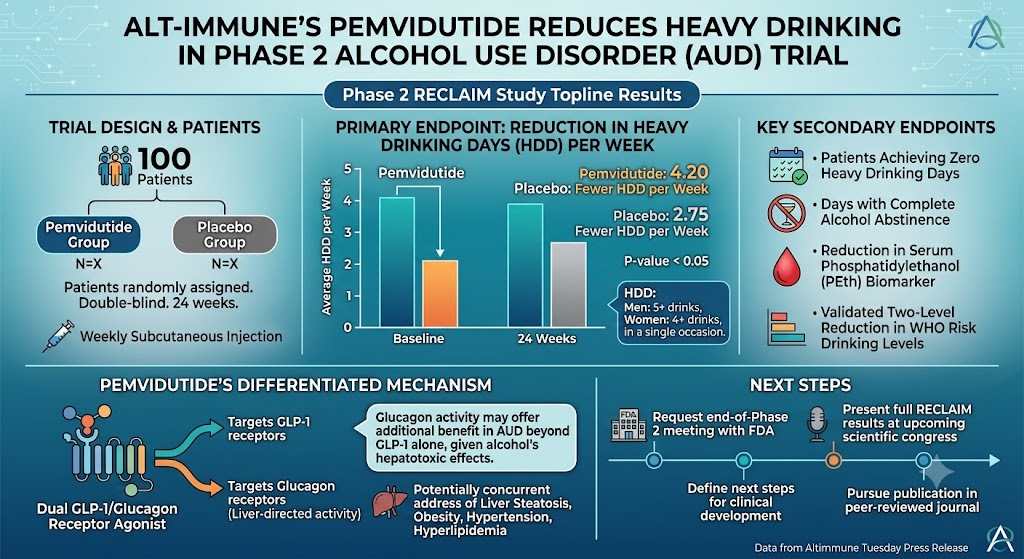
Pemvidutide also succeeded on several secondary endpoints. These included the proportion of patients achieving zero heavy drinking days during the final weeks of the study and the percentage of days with complete alcohol abstinence. Researchers also measured serum phosphatidylethanol levels, a biomarker used to track alcohol intake. Investigators reported a generally favorable tolerability profile across the treatment group.
Altimmune plans to request an end-of-Phase 2 meeting with the FDA to define next steps for pemvidutide in this indication. The company intends to present RECLAIM’s full results at an upcoming scientific congress and pursue publication in a peer-reviewed journal. Pemvidutide is administered as a weekly subcutaneous injection.
The drug’s dual mechanism targets both GLP-1 and glucagon receptors, distinguishing it from single-target GLP-1 therapies. Company executives have suggested that glucagon’s liver-directed activity may offer additional benefit in alcohol use disorder beyond GLP-1 agonism alone, given alcohol’s well-documented hepatotoxic effects. Analysts have noted that a substantial share of patients with alcohol use disorder also present with liver steatosis, obesity, hypertension, or hyperlipidemia, conditions that a dual-acting agent could plausibly address concurrently.
Beyond alcohol use disorder, Altimmune is developing pemvidutide for metabolic dysfunction-associated steatohepatitis. A Phase 2b study reported in November 2025 showed significantly improved disease resolution compared with placebo. Analysts have since projected substantial peak annual sales potential for pemvidutide in this indication, citing what they describe as class-leading efficacy signals.
Alcohol use disorder has become an increasingly active area of GLP-1 drug development. Eli Lilly is running two Phase 3 trials evaluating its investigational GLP-1/GIP asset in this population, with one trial enrolling patients specifically diagnosed with moderate-to-severe disorder. Baseline Therapeutics, a company that launched in January, is also advancing a weekly GLP-1 candidate for alcohol use disorder and has outlined plans to enter late-stage development this year.
These developments extend a broader pattern of GLP-1 class expansion beyond weight management and glycemic control. Researchers continue to investigate the drug class across neurodegenerative conditions and certain obesity-associated cancers. Regulatory clearance of new trial endpoints, such as the WHO risk drinking level measure, may accelerate development timelines for future entrants in this therapeutic space.