New AI Framework Helps Researchers Design Peptides That Turn Cellular Signals On or Off

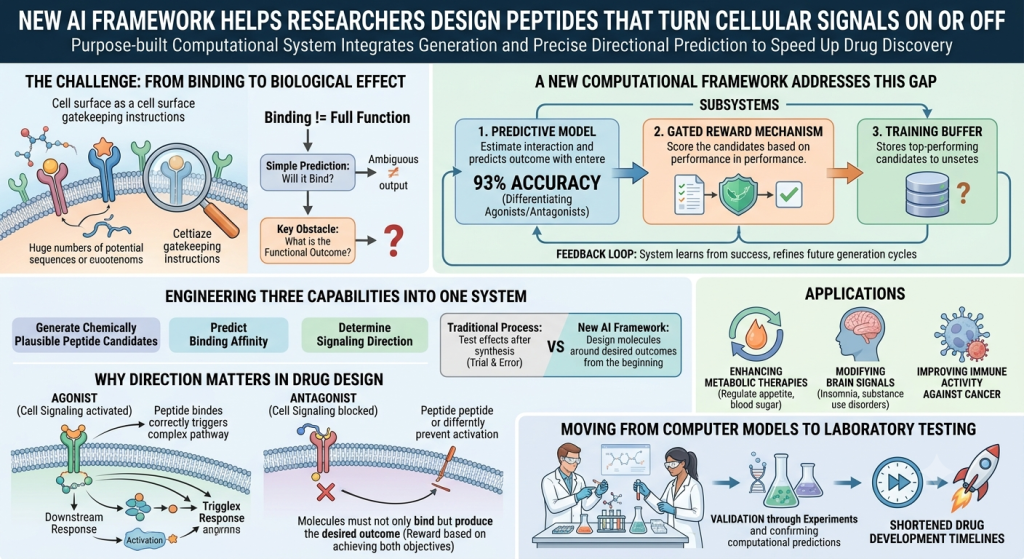
Scientists use artificial intelligence to create new peptide candidates and predict specific peptide properties. Combining these two abilities in one framework is a continuing challenge for drug developers. The main challenge is the scale and complexity. Researchers have to sift through an enormous number of potential sequences. While predicting binding events to targets is relatively simple, determining the exact functional outcome remains the key obstacle.
Molecular receptors are located on the surface of nearly every cell. They serve as gatekeepers, relaying external instructions to the inside of the cell. About one-third of approved drugs target this specific family of receptors. Therefore, reliable prediction tools are highly valuable across various therapeutic areas.
A new computational framework addresses this operational gap. It generates peptides while guiding the process toward a specific biological effect. Researchers presented their findings at a major machine learning conference, suggesting that this approach could significantly shorten drug development timelines. Instead of testing effects later, scientists can design molecules around desired outcomes. Potential applications include enhancing metabolic therapies and modifying specific brain signals. Additionally, the framework could improve immune cell activity against cancer. The project integrates intent directly into the initial design process.
Why Direction Matters in Drug Design
Cells continually receive chemical instructions from different signaling molecules. Receptors are the primary stations for these messages. When a molecule binds correctly, the receptor transfers instructions into the cell. Thus, binding alone does not determine how useful a treatment will be.
Some peptides act as agonists to activate downstream cellular responses. Others act as antagonists to block the receptor’s activity. Therefore, the direction of impact is crucial. A peptide can bind perfectly yet still fail to deliver any therapeutic benefit.
Building this new framework required tackling three connected problems at once. The system must generate chemically plausible peptide candidates, predict binding affinity for selected receptors, and determine if the interaction activates or suppresses signaling.
Developers likened this challenge to searching a forest for specific medicinal plants. Simply having structural plausibility and binding likelihood is not enough for success. Instead, the computational framework rewards candidates that achieve both objectives. Specifically, a molecule must bind and produce the desired outcome.
The system operates through three linked subsystems working together. A predictive model estimates how a specific peptide interacts with a receptor. A gated reward mechanism scores these candidates based on their performance. Finally, a training buffer stores the top-performing candidates for future generation cycles.
The system learns from its successes over time. As it identifies effective peptides, it refines the next rounds of generation. Consequently, each cycle becomes more focused than the last. This ongoing feedback loop improves the entire molecular design process.
Engineering Three Capabilities Into One System
Instead of testing effects later, scientists can design molecules around desired outcomes. Potential applications include enhancing metabolic therapies and modifying specific brain signals. Additionally, the framework could improve immune cell activity against cancer. The project integrates intent directly into the initial design process.
Cells continually receive chemical instructions from different signaling molecules. Receptors are the primary stations for these messages. When a molecule binds correctly, the receptor transfers instructions into the cell. Thus, binding alone does not determine how useful a treatment will be.
Some peptides act as agonists to activate downstream cellular responses. Others act as antagonists to block the receptor’s activity. Therefore, the direction of impact is crucial. A peptide can bind perfectly yet still fail to deliver any therapeutic benefit.
If a molecule misdirects receptor activity, it can lead to negative effects. This important distinction explains how modern metabolic drugs succeed. As agonists, these medications activate specific receptors in the gut and brain, triggering pathways that regulate appetite and blood sugar.
Testing Accuracy Against Known Drug Behavior
During initial testing, the research team evaluated the predictive model independently. This component achieved 93 percent accuracy, successfully differentiating between agonist and antagonist interactions. This performance is a strong outcome for a complex prediction task.
The team compared the generated candidates against established drug patterns. This process confirmed that the engineered agonist candidates used the correct activation sites, which are crucial for full function. Meanwhile, the antagonist candidates completely avoided those specific locations.
These structural patterns appeared independently, without direct guidance from the researchers. The system only received instructions concerning the desired directional outcome. Even so, the model autonomously recognized the correct biological mechanisms. This independent adaptation shows that the network learned important receptor biology.
The team saw similar success when testing a different type of receptor. This receptor regulates sleep, wakefulness, and reward behavior, making it relevant for insomnia and substance use disorders. Therefore, accurate directional prediction is valuable for future drug candidates.
Moving From Computer Models to Laboratory Testing
The research team has progressed beyond computational simulations. Scientists are now synthesizing these generated peptide candidates in laboratories. Future work includes laboratory testing to confirm the computational predictions, checking if the models lead to real biological effects.
The team has proven the framework’s capability to generate viable candidates. The next crucial step is to validate these predictions through experiments. Successful validation could enable researchers to design medicines based on outcomes from the beginning, avoiding traditional trial and error after synthesis.
If experimental results support the findings, this tool will change the way drug discovery occurs. Instead of treating discovery as a problem to solve later, intent will enter early stages. This shift is significant for therapeutic areas that rely on these targets, potentially speeding up clinical development timelines.
Conclusion
In summary, this new computational framework introduces a purposeful method to molecular design. By merging generation with precise directional prediction, the system eliminates traditional testing bottlenecks. This integration allows researchers to target complex cellular receptors with new accuracy.
Ultimately, moving from computational models to laboratory validation represents a major step forward. If experimental results align with the initial predictions, drug discovery timelines will shorten considerably. This advancement lays the groundwork for developing highly targeted therapies for complex diseases.
References
Hauser, A. S., Attwood, M. M., Rask-Andersen, M., Schiöth, H. B., & Gloriam, D. E. (2017). Trends in GPCR drug discovery: New agents, targets and indications. Nature Reviews Drug Discovery, 16(12), 829–842. https://doi.org/10.1038/nrd.2017.178
Jumper, J., Evans, R., Pritzel, A., Green, T., Figurnov, M., Ronneberger, O., … Hassabis, D. (2021). Highly accurate protein structure prediction with AlphaFold. Nature, 596(7873), 583–589. https://doi.org/10.1038/s41586-021-03819-2
Makowski, E. K., Boehringer, D., & Schulte, G. (2021). Signaling pathways and pharmacology of G protein-coupled receptors. Pharmacological Reviews, 73(2), 411–463. https://doi.org/10.1124/pharmrev.120.000082
Muttenthaler, M., King, G. F., Adams, D. J., & Alewood, P. F. (2021). Trends in peptide drug discovery. Nature Reviews Drug Discovery, 20(4), 309–325. https://doi.org/10.1038/s41573-020-00135-8
Santos, R., Ursu, O., Gaulton, A., Bento, A. P., Donadi, R. S., Bologa, C. G., … Overington, J. P. (2017). A comprehensive map of molecular drug targets. Nature Reviews Drug Discovery, 16(1), 19–34. https://doi.org/10.1038/nrd.2016.230