Market Expansion and Pricing Shifts for GLP-1 Weight Loss Medications

In recent months, there has been a major shift in the glucagon-like peptide-1 receptor agonist landscape. To satisfy the increasing clinical demand, one producer introduced an injectable formulation with a greater dose. Additionally, a new oral drug for weight loss was approved by the Food and Drug Administration. Patients with persistent obesity now have more therapy options thanks to its approval.
These healthcare advancements come into a market where self-pay prices have significantly decreased. Some goods currently have monthly cash pricing as low as $149. Because of this, the baseline is no longer defined by prior list prices that were higher than $1,000. These days, manufacturers sell a variety of injectables for between $299 and $399 a month.
There is still very little insurance coverage for prescription drugs used to control weight. There is a large coverage gap, according to survey data from a national health policy organization. In 2025, these therapies were covered by just 19% of major commercial policies. As a result, a lot of patients have to deal with complicated out-of-pocket payment procedures.
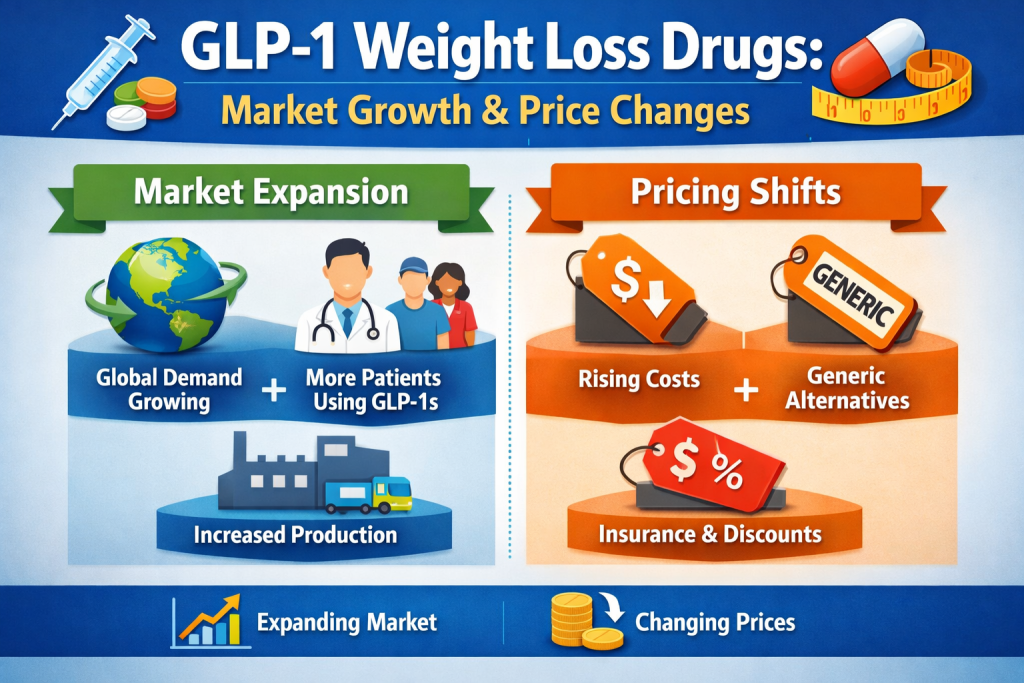
Manufacturer savings programs and prescription discount platforms are frequently used by patients. By using these techniques, people can get around the absence of traditional insurance support. Additionally, certain savings cards lower monthly co-pays to $25. As a result, consumers and producers bear the financial burden instead of insurance.
Several consumer-facing platforms now facilitate access to approved products. A federally operated platform recently launched to aggregate discounted pricing for patients. Along with this, major digital retailers announced plans for same-day medication delivery. These initiatives aim to streamline the distribution of oral and injectable formulations.
Additionally, telehealth providers use specialized membership structures to distribute medications. In addition to the expense of medications, these services usually include monthly fees. Furthermore, the market for compounded medications has recently come under closer regulatory scrutiny. As a result, platforms now give official pharmaceutical product distribution top priority.
To prevent unforeseen financial liabilities, patients should carefully read the program terms. Manufacturer discounts are not included in the annual deductible calculations for certain insurance policies. Patients may incur significant expenses later in the plan year as a result. Additionally, a lot of self-pay discount schemes have time or usage restrictions.
Introductory pricing for certain injectables often escalates after the initial two months. Clinical evidence indicates that weight regain frequently occurs following the discontinuation of therapy. Accordingly, these medications function best as long-term maintenance solutions. Stability in pricing and coverage remains a central determinant for patient success.
Patients should carefully understand the program terms to avoid unanticipated financial liabilities. For some insurance policies, manufacturer discounts are not factored into the annual deductible calculations. As a result, patients may face substantial costs later in the plan year. Many self-pay discount programs may include usage or time limits.
After the first two months, introductory prices for several injectables frequently increase. There is clinical evidence that weight gain often happens when therapy is stopped. As a result, these drugs work best as long-term maintenance remedies. Price and coverage stability continues to be a key factor in determining patient success.