GLP-1 Pill Coupons and Savings Cards

The arrival of oral GLP-1 medications marks a major shift in how we manage metabolic health today. Despite this progress, the high price of these pills often stops people from starting their treatment. Manufacturers have responded by creating coupon programs and savings cards to help lower these daily costs. These financial tools operate under strict rules that determine who can use them and how.
How Pharmaceutical Coupon Programs Function
Pharmaceutical coupons act as instant discounts that lower what you pay at the pharmacy counter. Companies design these programs to reduce the specific copayments required by private insurance plans. The discount applies the moment you pick up your medicine, so no reimbursement forms are needed. This immediate help is vital because high costs often lead people to stop taking their pills.
Savings cards work similarly but require you to activate a special ID number. You simply show this number along with your insurance card to the pharmacist. The pharmacy system then subtracts the manufacturer’s discount before giving you the final bill. Consequently, you pay a much lower price while the drug company covers the remaining balance.
Legal and Regulatory Limits on Savings Cards
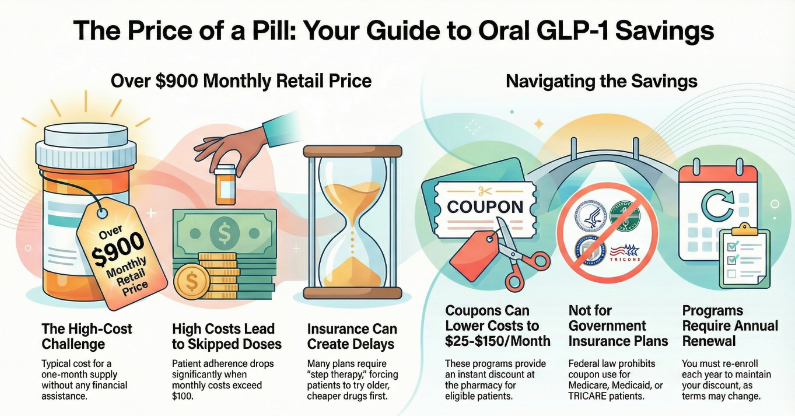
Federal laws strictly forbid using manufacturer coupons for any government-funded healthcare plans. This means people using Medicare, Medicaid, or TRICARE cannot use these specific discounts. The rule exists to prevent private companies from influencing how public tax dollars are spent. Therefore, these savings programs are only available to those with private, commercial insurance.
This legal restriction creates a difficult gap for many seniors and lower-income families. Medicare recipients often have the highest need for these drugs, but are legally excluded from coupons. Medicaid participants face the same struggle even when they have very limited budgets for healthcare. In light of this, your insurance type matters more than your medical need when it comes to cost.
Pricing Dynamics for Oral GLP-1 Formulations
The first oral GLP-1 pill provides a welcome alternative for those who dislike weekly needles. This daily tablet offers a simpler way to manage diabetes without the stress of injections. However, the retail price for these pills can stay well above $900 per month without help. Furthermore, many insurance plans require extra paperwork from your doctor before they will agree to pay.
Manufacturer coupons typically bring these monthly costs down to somewhere between $25 and $150. The exact amount you save depends on your specific insurance and the pharmacy you visit. Notably, most of these programs have a maximum limit on how much they pay each year. If you hit that limit, you may have to pay the full insurance price again.
The Impact of Costs on Patient Health Results
Financial hurdles directly change how often patients fill their prescriptions over the long term. Research shows that people are much more likely to skip doses when the price is high. Adherence rates usually drop fast whenever the monthly cost goes over the $100 mark. Given this, even a small price increase can disrupt a patient’s entire treatment plan.
The medical results of skipping these pills include poor blood sugar control and less weight loss. GLP-1 medications work best when they stay at a steady level in your body. Inconsistent use prevents the medicine from reaching the strength it needs to truly work well. Moreover, stopping the drug often leads to gaining back weight and seeing health issues return.
Insurance Approval and Step Therapy Requirements
Prior authorization is a procedure that insurers frequently utilize to restrict the use of costly medications. This implies that documentation proving the drug is necessary for your health must be sent by your doctor. A definitive diagnosis of diabetes and a history of prior treatments are typically necessary for GLP-1 medications. Your start date is frequently postponed by a few days while the documentation is examined.
Another policy that compels you to start with less expensive, older medications is step therapy. Before they will pay for a more recent GLP-1, many plans require you to fail on basic drugs. By prioritizing generic choices, these regulations seek to save the insurance company money. However, individuals who would benefit most from contemporary oral treatments may be delayed by these delays.
Comparing Injectable and Oral Financial Support
Injectable GLP-1 drugs use similar coupon structures to the newer oral versions. However, insurance rules often change depending on whether the drug is for weight or diabetes. Most plans are much more willing to pay for diabetes care than for obesity alone. This reflects an older medical view that does not always treat obesity as a chronic disease.
For those who are obese but do not have diabetes, this puts them in a difficult predicament. Coupons benefit people with private insurance, but for others, the out-of-pocket expenses are still very expensive. In fact, without insurance, weight-loss versions of these medications can cost more than $1,300 per month. In addition, the cost difference continues to be a significant obstacle for many people looking for assistance.
Yearly Renewal and Benefit Caps
Most manufacturer savings programs reset every year and require you to sign up again. You must check your eligibility and get a new card to keep your discount. The terms of the program might also change, such as the total amount they will cover. Therefore, it is a good idea to review your program details every January.
Some programs also have a lifetime limit on the total help they will provide. Once you reach that maximum, you may lose access to that specific discount forever. This is a real concern for people who need these medications for many years. Building on this, you should talk to your doctor about long-term costs during your visits.
Other Options for Financial Assistance
Patient assistance programs differ in that they frequently offer the medication at no cost. Those with extremely low incomes and no insurance at all are eligible for these programs. You must provide documentation of your household size and income during the application process. You may require a temporary plan for your medication because approval can take several weeks. Regardless of your insurance situation, you can also save money by using pharmacy discount cards.
You can reduce your retail expenses by using these cards to directly negotiate cheaper pricing with pharmacies. However, manufacturer coupons typically offer significantly greater savings than brand-name GLP-1 medications. Because of this, the majority of people only utilize these cards as a last resort.
Future Trends in Medication Accessibility
New evidence showing that GLP-1s protect the heart and kidneys may soon change insurance rules. As these pills gain more official uses, insurers might make them easier to get. Proving that a drug prevents heart attacks makes it much more valuable to a health plan. Accordingly, we may see fewer hurdles like step therapy in the coming years.
Generic versions will also eventually hit the market and bring the prices down significantly. Patents for the current oral GLP-1 drugs will begin to expire in the early 2030s. Generic competition usually drops the cost of a drug by about 80 percent quite quickly. With this in mind, the long-term future for these medications looks much more affordable.
Better technology for making these pills could also lower the cost of every dose. Current versions require special coatings to help your body absorb the medicine properly. New science might make this process simpler and much cheaper for the drug companies. Meanwhile, healthcare systems will continue to rely on the current coupon and assistance programs.
Conclusion
Navigating the financial landscape of oral GLP-1 medications requires both persistence and careful planning. While these advanced therapies offer significant health benefits, their high costs remain a major challenge for many. Manufacturer coupons and savings cards provide a vital bridge to affordability for those with commercial insurance. Nevertheless, the legal exclusions for government-funded plans leave a significant portion of the population seeking alternative solutions.
Access to these life-changing treatments should ideally depend on medical necessity rather than insurance classification. As clinical evidence grows and patents eventually expire, the market will likely become more competitive and affordable. In light of this, staying informed about renewal cycles and eligibility rules is the best way to ensure steady treatment. Working closely with healthcare providers and exploring all assistance options helps patients maintain their long-term health goals.