GLP-1 Receptor Agonists Linked to Greater Physical Activity in MS; BLA Filed for Z-Rostudirsen; Ofatumumab Shows Superiority Over Rituximab in MOGAD

New data presented at the 2026 Consortium of Multiple Sclerosis Centers Annual Meeting indicate that glucagon-like peptide-1 receptor agonists (GLP-1 RAs) significantly improve physical activity levels in patients with multiple sclerosis (MS). Researchers evaluated self-reported moderate-to-vigorous physical activity alongside SymptoMScreen PRO scores across 13 neurologic symptom domains. Physical activity rose from 52.3 minutes per week at baseline to 115.7 minutes per week following GLP-1 therapy initiation. This represents a mean weekly increase of 65.8 minutes (95% CI, 48.5-83.0; P <.001).
The findings are clinically notable given the well-documented burden of fatigue and reduced mobility in MS populations. GLP-1 RAs, originally developed for type 2 diabetes and weight management, have demonstrated expanding therapeutic relevance across neurologic conditions. Improvements across multiple patient-reported symptom domains further strengthen this signal. Consequently, these results support ongoing investigation into GLP-1 RA use as adjunctive therapy in MS care.
Dyne Therapeutics has submitted a biologics license application (BLA) to the Food and Drug Administration (FDA) for zeleciment rostudirsen (z-rostudirsen) under the accelerated approval pathway. The candidate targets patients with Duchenne muscular dystrophy (DMD) amenable to exon 51 skipping, a genetically defined subset with limited therapeutic options. The submission draws on data from the phase 1/2 DELIVER trial (NCT05524883), which demonstrated statistically significant increases in dystrophin production alongside functional endpoint improvements and an acceptable safety profile. Dyne has additionally requested Priority Review, which, if granted, would reduce the standard FDA review period from 10 months to 6 months.
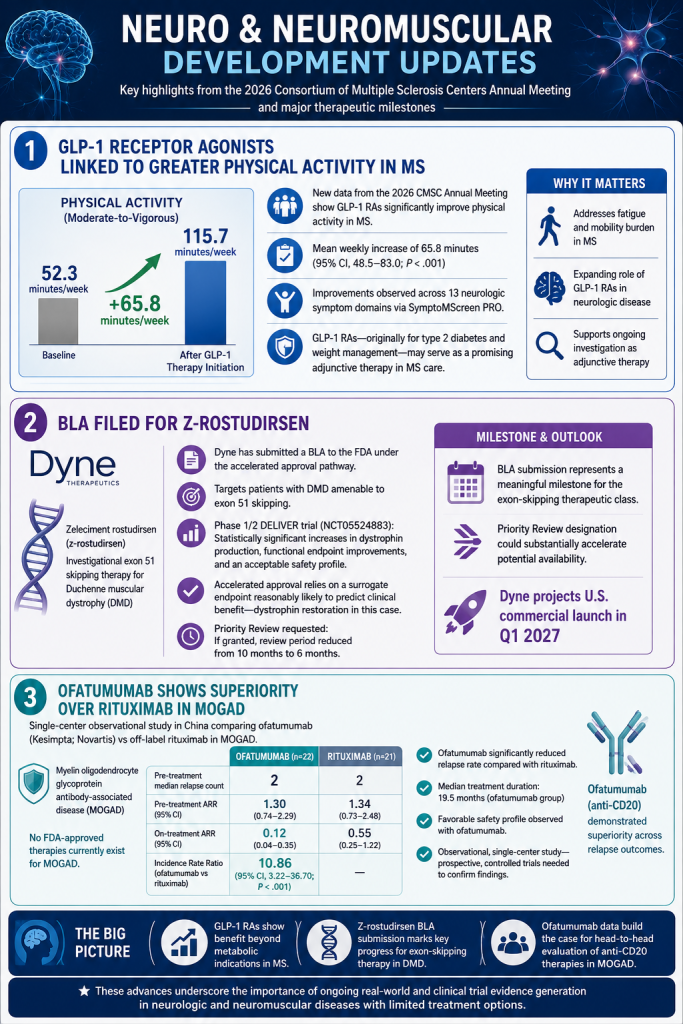
The regulatory filing represents a meaningful milestone for the exon-skipping therapeutic class. Accelerated approval, when granted, relies on a surrogate or intermediate clinical endpoint reasonably likely to predict clinical benefit. Dystrophin restoration serves as that surrogate in this application. Moreover, a confirmed Priority Review designation would substantially accelerate the potential availability of this therapy. Dyne currently projects a U.S. commercial launch in the first quarter of 2027.
A single-center observational study conducted in China evaluated ofatumumab (Kesimpta; Novartis) against off-label rituximab in patients with myelin oligodendrocyte glycoprotein antibody-associated disease (MOGAD). Among 22 patients receiving ofatumumab, the median pre-treatment relapse count was 2, with an annualized relapse rate (ARR) of 1.30 (95% CI, 0.74-2.29). Over a median treatment duration of 19.5 months, the ARR declined sharply to 0.12 (95% CI, 0.04-0.35), yielding an incidence rate ratio of 10.86 (95% CI, 3.22-36.70; P <.001).
In the rituximab cohort of 21 patients, the pre-treatment ARR was 1.34 (95% CI, 0.73-2.48), a figure comparable to that of the ofatumumab group at baseline. The comparative reduction favored ofatumumab across relapse outcomes. Notably, ofatumumab also demonstrated a favorable safety profile throughout the observation period. These findings, while limited by their observational and single-center design, nonetheless provide clinically relevant comparative data in a condition where no FDA-approved therapies currently exist for MOGAD.
The convergence of these developments reflects broadening therapeutic frontiers across neurologic and neuromuscular disease. GLP-1 RAs continue to demonstrate utility beyond metabolic indications. Meanwhile, the MOGAD findings build a case for prospective, controlled trials comparing anti-CD20 agents in this population. Each of these advances, accordingly, underscores the importance of ongoing real-world and clinical trial evidence generation in conditions with historically limited treatment options.