GLP-1 Growth Drives Concentration Risk in Pharmaceutical Research

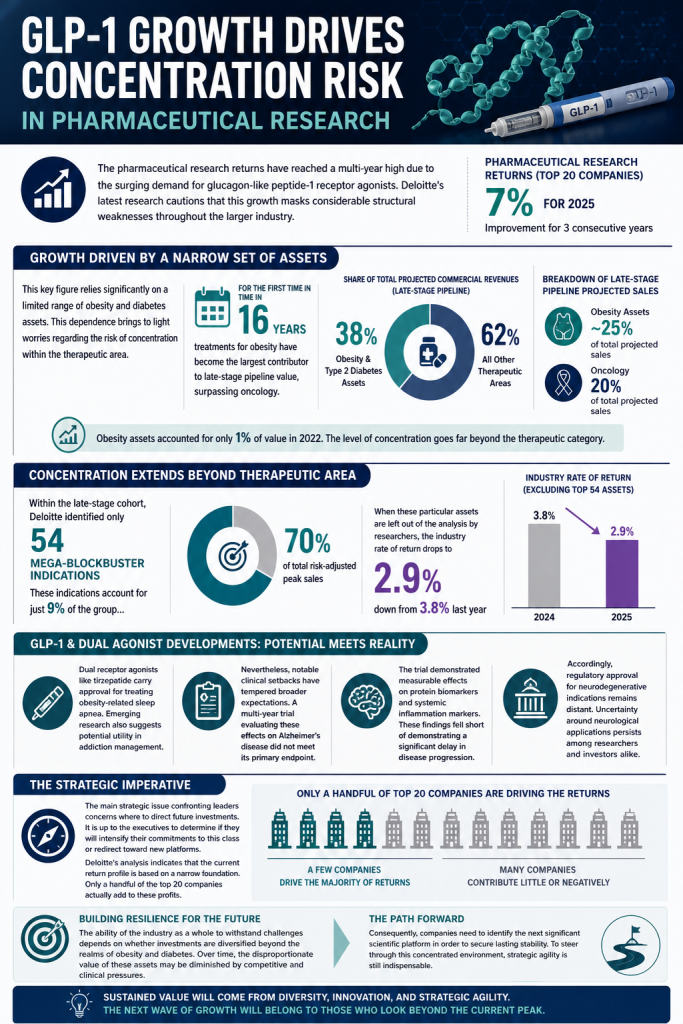
The pharmaceutical research returns have reached a multi-year high due to the surging demand for glucagon-like peptide-1 receptor agonists. Deloitte’s latest research cautions that this growth masks considerable structural weaknesses throughout the larger industry. The most recent examination of the leading 20 pharmaceutical companies worldwide discovered that returns attained 7% for the year 2025. This number indicates that there has been an improvement for three consecutive years.
This key figure relies significantly on a limited range of obesity and diabetes assets. This dependence brings to light worries regarding the risk of concentration within the therapeutic area. For the first time in 16 years, treatments for obesity have become the largest contributor to late-stage pipeline value, surpassing oncology. Drugs aimed at obesity and type 2 diabetes make up 38% of all anticipated commercial revenues.
Specifically, obesity assets account for about 25% of the total projected sales within the late-stage pipeline. In the meantime, the oncology share has fallen to 20%. This change seems especially remarkable considering that obesity assets accounted for only 1% of value in 2022. In light of this, the level of concentration goes far beyond the therapeutic category.
Within the late-stage cohort, Deloitte identified only 54 mega-blockbuster indications. These indications account for just 9% of the group yet produce 70% of total risk-adjusted peak sales. When these particular assets are left out of the analysis by researchers, the industry rate of return drops to 2.9%. This number indicates a drop from 3.8% last year.
Specifically, obesity assets account for about 25% of the total projected sales within the late-stage pipeline. In the meantime, the oncology share has fallen to 20%. This change seems especially remarkable considering that obesity assets accounted for only 1% of value in 2022. In light of this, the level of concentration goes far beyond the therapeutic category.
Dual receptor agonists like tirzepatide carry approval for treating obesity-related sleep apnea. Emerging research also suggests potential utility in addiction management. Nevertheless, notable clinical setbacks have tempered broader expectations. A multi-year trial evaluating these effects on Alzheimer’s disease did not meet its primary endpoint.
The trial demonstrated measurable effects on protein biomarkers and systemic inflammation markers. These findings fell short of demonstrating a significant delay in disease progression. Accordingly, regulatory approval for neurodegenerative indications remains distant. Uncertainty around neurological applications persists among researchers and investors alike.
The main strategic issue confronting leaders concerns where to direct future investments. It is up to the executives to determine if they will intensify their commitments to this class or redirect toward new platforms. Deloitte’s analysis indicates that the current return profile is based on a narrow foundation. Only a handful of the top 20 companies actually add to these profits.
The ability of the industry as a whole to withstand challenges depends on whether investments are diversified beyond the realms of obesity and diabetes. Over time, the disproportionate value of these assets may be diminished by competitive and clinical pressures. Consequently, companies need to identify the next significant scientific platform in order to secure lasting stability. To steer through this concentrated environment, strategic agility is still indispensable.