Does Zepbound Cause Body Aches? Here’s What’s Really Going On

If you’ve recently started taking Zepbound (tirzepatide) and noticed your muscles feeling sore or achy, it’s completely normal to wonder if the medicine is to blame.
The short answer? Zepbound itself doesn’t directly cause body aches. Massive clinical studies showed that people on Zepbound reported muscle pain at pretty much the exact same rate as people taking a placebo (a dummy shot).
That said, body aches do happen while on Zepbound, but usually as an indirect side effect of how the drug changes your daily habits, appetite, and routine.
Here is a simple look at why you might be feeling sore and how to fix it.
3 Reasons You Might Feel Sore on Zepbound
While the medication isn’t directly targeting your muscles, the big changes happening in your body can cause some temporary aching.
You Might Be Dehydrated
Zepbound works by curbing your appetite, but it often shuts down your thirst cues, too. It is surprisingly easy to forget to drink enough water throughout the day.
If you are also dealing with stomach side effects like nausea, vomiting, or diarrhea, your body is losing fluids even faster. When you get dehydrated, you lose essential electrolytes (like magnesium and potassium), which leads directly to:
- Muscle tightness and painful cramping
- A dull, generalized body ache
- Fatigue and headaches
Your Movement or Body Is Changing
As weight starts coming off, many people feel a burst of energy and start moving more, walking further, or trying new workouts.
- New workouts: If you start using muscles you haven’t worked in a while, you’ll get delayed onset muscle soreness (DOMS). This usually peaks 1 to 2 days after moving and goes away on its own.
- Shifting weight: Losing weight changes your center of gravity and how you walk. Your joints, back, and leg muscles are literally recalibrating to your new body frame, which can cause temporary soreness.
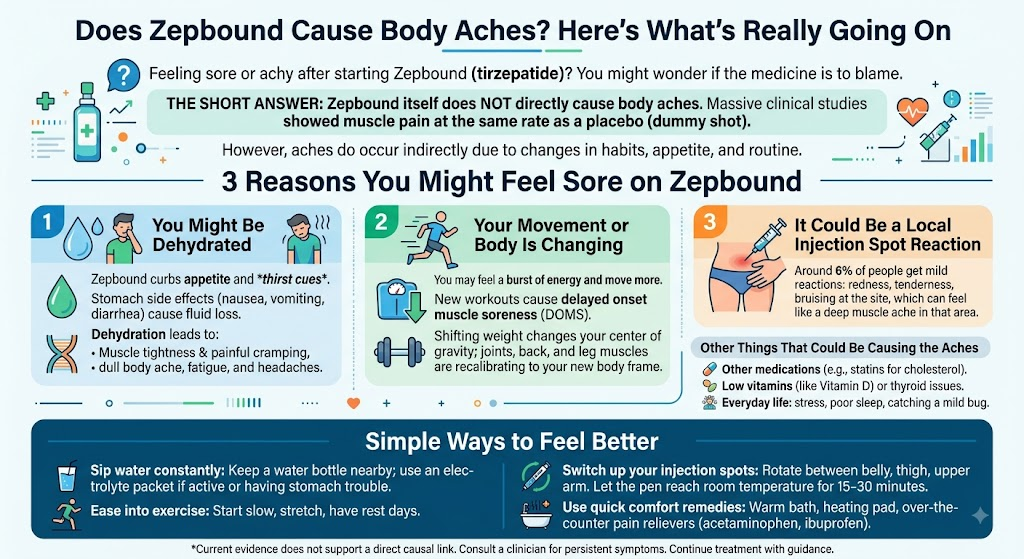
It Could Be a Local Injection Spot Reaction
Around 6% of people get mild reactions right where they inject the shot. Redness, tenderness, or slight bruising at the injection site (like your thigh or stomach) can sometimes feel like a deep muscle ache in that area.
Other Things That Could Be Causing the Aches
It’s always worth looking at the bigger picture before assuming Zepbound is the culprit:
- Other medications: Common cholesterol drugs (statins) are well-known for causing muscle pain.
- Low vitamins: Being low on Vitamin D or having thyroid issues frequently shows up as muscle soreness.
- Everyday life: Stress, poor sleep, or catching a mild bug can leave your body feeling run down.
Simple Ways to Feel Better
If you’re dealing with mild aches, a few small tweaks can make a big difference:
- Sip water constantly: Don’t wait until you’re parched. Keep a water bottle nearby and consider mixing in an electrolyte packet if you’ve been working out or having stomach trouble.
- Ease into exercise: Give your body time to adjust. Start slow, stretch, and give yourself rest days between active workouts.
- Switch up your injection spots: Rotate between your belly, thigh, and upper arm each week. Let the pen sit out for 15–30 minutes so it reaches room temperature before you use it. Cold medicine tends to sting more.
- Use quick comfort remedies: A warm bath, a heating pad, or standard over-the-counter pain relievers like acetaminophen or ibuprofen can work wonders.
Conclusion
Current evidence does not support a direct causal link between tirzepatide and body aches. Indirect mechanisms, including dehydration, increased physical activity, and injection site reactions, likely account for most reported cases. Confounding medications and coincidental medical conditions further complicate symptom attribution in clinical practice. Clinicians should therefore maintain a broad differential diagnosis when evaluating musculoskeletal complaints in this population.
Ongoing pharmacovigilance and post-marketing surveillance will continue to refine understanding of tirzepatide’s long-term safety profile. As real-world use expands beyond controlled trial populations, additional patterns may become apparent over time. Nonetheless, current data support continued use of Zepbound as an effective option for obesity and weight management. Patients experiencing persistent or worsening symptoms should always seek individualized clinical guidance rather than discontinuing treatment independently.
References
- Jastreboff, A. M., Aronne, L. J., Ahmad, N. N., Wharton, S., Connery, L., Alves, B., Kiyosue, A., Zhang, S., Liu, B., Bunck, M. C., & Stefanski, A. (2022). Tirzepatide once weekly for the treatment of obesity. New England Journal of Medicine, 387(3), 205-216. https://doi.org/10.1056/NEJMoa2206038
- U.S. Food and Drug Administration. (2023). Zepbound (tirzepatide) injection: Prescribing information. https://www.accessdata.fda.gov/drugsatfda_docs/label/2023/217806s000lbl.pdf
- Popkin, B. M., D’Anci, K. E., & Rosenberg, I. H. (2010). Water, hydration, and health. Nutrition Reviews, 68(8), 439-458. https://doi.org/10.1111/j.1753-4887.2010.00304.x