Choosing a GLP-1 Specialist: What Rochester Patients Should Know Before Starting

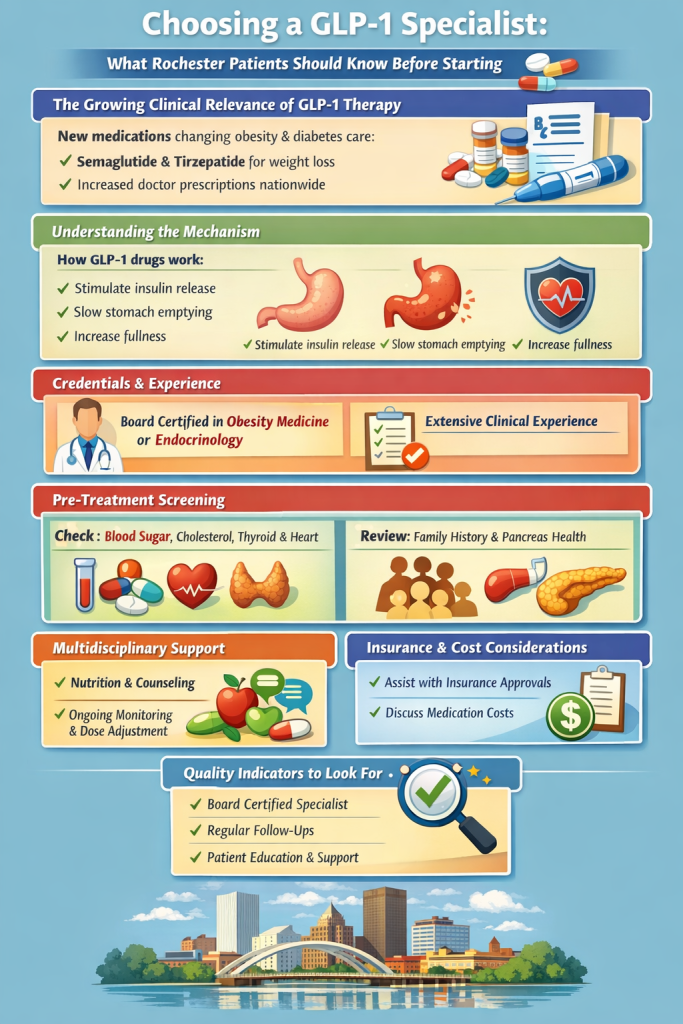
New medications have changed how doctors treat obesity and type 2 diabetes. Famous drugs like semaglutide and tirzepatide help people lose weight for a long time. Because of these results, more doctors across the country are writing prescriptions. Federal agencies have also approved these drugs for more types of patients recently.
The medical world now offers several options that work in different ways. One drug helps with chronic weight management while another focuses on blood sugar levels. A different dual-action medication helps patients reach even higher weight loss goals. Therefore, patients must decide which specialist can help them find the right fit.
Understanding the Mechanism behind GLP-1 Agents
These drugs work by mimicking hormones that tell your body to release insulin. They slow down how fast your stomach empties and make you feel full. As a result, you eat fewer calories and your blood sugar stays steady. Furthermore, studies show these medications can even protect your heart from future problems.
Patients using semaglutide often lose about 15 percent of their total body weight. Those using tirzepatide may see even higher numbers in some clinical research studies. Notably, these results happen under perfect conditions and might vary for each person. Nevertheless, a good specialist is necessary to make sure the treatment works well.
Credentials and Specialist Qualifications
You should check a doctor’s training before you start any new medical plan. Doctors focused on obesity medicine or hormone health usually have the most experience. Indeed, a special board certification shows the doctor has passed extra tests in weight management. Accordingly, this credential helps you find a true expert instead of a generalist.
Hormone doctors, known as endocrinologists, understand the deep causes of weight gain. They look for thyroid issues or insulin problems that might make losing weight hard. Building on this, they know how to read complex blood tests very accurately. Hence, their advanced training is perfect for patients with complicated health histories.
Book learning is important, but a doctor also needs real-world experience with patients. Clinicians who prescribe these drugs every day know how to adjust the doses. Notably, they have better ways to handle side effects like nausea or stomach pain. A specialist’s experience with these issues directly helps you stay on the medication.
Seeing many patients helps a doctor learn how to handle different health challenges. Experienced specialists know what to do if the medicine stops working as expected. In view of this, a busy clinic usually means the doctor has seen it all. Thus, asking about their experience level is a smart move for any patient.
Pre Initiation Assessment and Screening
A complete health checkup before starting helps keep you safe and successful. Your specialist should test your blood sugar, cholesterol, and kidney health first. In light of this, checking your heart health helps the doctor choose the safest path. Furthermore, they must check your thyroid because of specific risks linked to these drugs.
To qualify for weight loss versions, patients usually need a specific body mass. Other versions of the drug are strictly for people living with type 2 diabetes. Similarly, some newer drugs are still waiting for full approval for certain health uses. Consequently, a thorough exam ensures you are actually eligible for the medication you receive.
Checking for health risks protects you from getting sick from a new medicine. These specific drugs have a warning about a rare type of thyroid cancer. Specialists must ask if anyone in your family has ever had this illness. As a result, patients with certain family histories should not use these medications at all.
Doctors must also check if you have ever had problems with your pancreas. They will look at your history to see if the drug is safe. Accordingly, people with past pancreas issues might need to try a different type of medicine. This careful checking is exactly what a high-quality specialist should do for you.
Multidisciplinary Support and Long Term Management
These drugs work best when you have a full team of experts helping. Great clinics often have dietitians who teach you how to eat for your goals. Moreover, talking to a counselor can help with habits like eating when you feel stressed. These extra supports help you keep the weight off even after the treatment.
Research proves that combining medicine with lifestyle changes leads to much better results. Having a coach for exercise also helps you keep your muscles strong while losing. Building on this, a team approach is much more powerful than just taking a pill. Hence, look for a practice that offers more than just a prescription.
Regular checkups are what separate great medical care from a basic doctor’s visit. Specialists should schedule visits to see how your body is reacting to the drug. Notably, testing your blood every few months helps manage diabetes and other health markers. In view of this, regular monitoring catches small problems before they become big ones.
Your dose should go up slowly based on the rules made by the manufacturer. This usually happens every four weeks until you reach the full dose for you. Likewise, starting with a small amount helps your stomach get used to the new medicine. A specialist’s focus on these steps shows they care about your safety first.
Insurance, Access, and Financial Considerations
Getting insurance to pay for these expensive drugs can be very difficult today. Many plans do not cover weight loss drugs as easily as they cover others. In light of this, find a clinic with staff who help with insurance paperwork. Furthermore, they might know about coupons from the drug companies that save you money.
Sometimes one drug is covered by your plan while a similar one is not. Consequently, your insurance might actually decide which medication you end up taking first. Nevertheless, the doctor must still make sure the drug is the right medical choice. Accordingly, a good specialist will talk openly about costs before you start the program.
Identifying Quality Indicators and Warning Signs
Some red flags can tell you if a doctor is not being careful enough. You should be worried if they give you drugs without doing blood tests first. Similarly, a practice that does not schedule follow-up visits is not following the rules. Patients should always look for a doctor who takes the time for safety.
Online clinics have grown fast, but you must check them very carefully before joining. Some internet doctors do not perform a real exam or check your lab work. Hence, you must decide if the convenience is worth the risk to your health. Convenience should never be more important than a thorough and safe medical exam.
Good specialists usually have specific signs of quality that you can see easily. Being a member of a national weight loss medical group is a great sign. Furthermore, they should stay up to date on the newest research in their field. Notably, doctors who teach other doctors are often the most knowledgeable experts you can find.
How a doctor talks to you also tells you a lot about their care. They should explain the side effects and tell you exactly what to expect. In light of this, being honest about the timeline helps you stay on track. Moreover, you should be able to reach the office easily if you have questions.
Conclusion
GLP-1 drugs offer a great chance for people to improve their long-term health. These medications have shown amazing results for many people in large medical studies. However, staying safe depends on having a doctor who knows exactly what they are doing. In view of this, choosing your specialist is the most important first step you take.
The science behind these drugs is changing fast as new studies come out daily. Nonetheless, the need for a careful doctor and regular checkups will never change. Accordingly, following these tips will help you find a safe and successful medical path. A strong relationship with your doctor is the key to reaching your goals.
References
Davies, M., Færch, L., Jeppesen, O. K., Pakseresht, A., Pedersen, S. D., & Perreault, L. (2021). Semaglutide 2·4 mg once a week in adults with overweight or obesity, and type 2 diabetes (STEP 2): A randomised, double-blind, placebo-controlled, phase 3 trial. The Lancet, 397(10278), 971–984. https://doi.org/10.1016/S0140-6736(21)00213-0
Jastreboff, A. M., Aronne, L. J., Ahmad, N. N., Wharton, S., Connery, L., Alves, B., Kiyosue, A., Zhang, S., Liu, B., Bunck, M. C., & Stefanski, A. (2022). Tirzepatide once weekly for the treatment of obesity. New England Journal of Medicine, 387(3), 205–216. https://doi.org/10.1056/NEJMoa2206038
Wilding, J. P. H., Batterham, R. L., Calanna, S., Davies, M., Van Gaal, L. F., Lingvay, I., McGowan, B. M., Rosenstock, J., Tran, M. T. D., Wadden, T. A., Wharton, S., Yokote, K., Zeuthen, N., & Kushner, R. F. (2021). Once-weekly semaglutide in adults with overweight or obesity. New England Journal of Medicine, 384(11), 989–1002. https://doi.org/10.1056/NEJMoa2032183