GLP-1 Receptor Agonist Utilization Trends: What Real-World Data Reveals

Prescriptions for glucagon-like peptide-1 receptor agonists have grown significantly in the national health care system. Clinicians are seeing more patients looking for these therapies for weight loss, not just for managing blood sugar. This change shows the growing evidence about the effectiveness of semaglutide and similar drugs for treating obesity. Real-world data now provide a better understanding of how these medications work outside of controlled trial settings. These patterns differ notably from those seen in registration studies.
Prescription Growth among Non-diabetic Populations
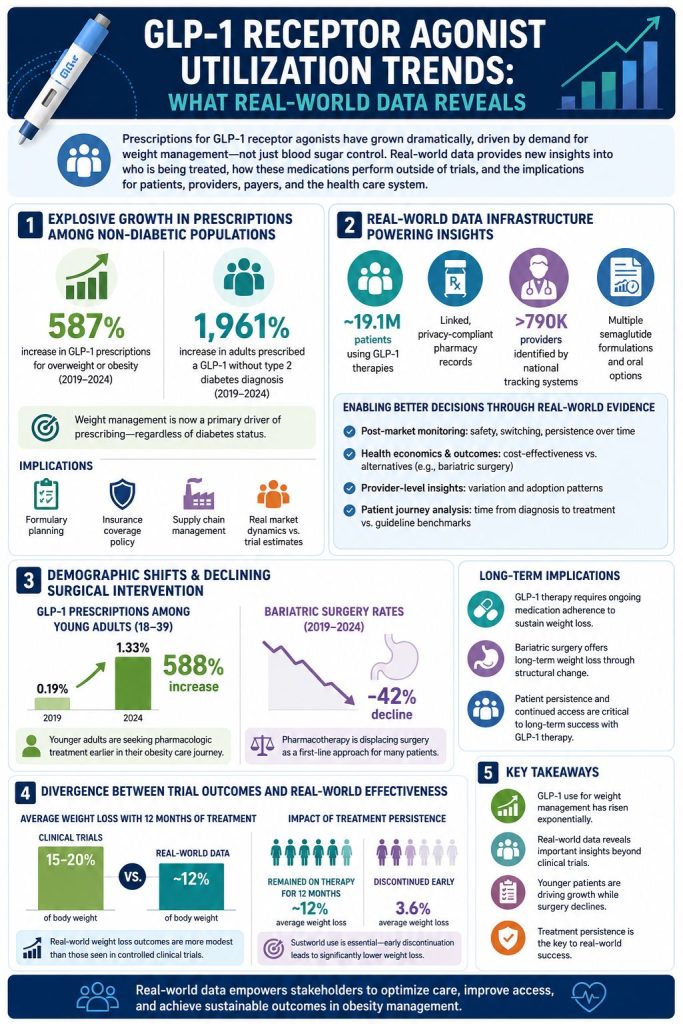
Data from independent health registries show that prescriptions for GLP-1 medications to treat overweight or obesity increased by 587 percent between 2019 and 2024. This growth significantly exceeds past prescribing trends for any previous class of obesity medication. Notably, the number of adults prescribed a GLP-1 drug without a type 2 diabetes diagnosis rose by nearly 1,961 percent during the same period. These numbers suggest a major shift in clinical guidelines, with weight management now driving prescription numbers regardless of diabetes status.
This trend affects formulary planning, insurance coverage policy, and supply chain management in the pharmaceutical industry. Manufacturers have responded by increasing production capacity for these in-demand medications. Meanwhile, insurers face growing pressure to clarify coverage criteria as demand expands beyond the usual type 2 diabetes populations. As a result, prescribing data have become crucial for understanding real market dynamics instead of relying on estimates from clinical trials.
Real-world Data Infrastructure Supporting GLP-1 Analysis
Large database platforms now track prescription activity across about 19.1 million patients using GLP-1 therapies. This dataset includes linked, privacy-compliant pharmacy records for different semaglutide formulations and oral options. It also has prescribing information from over 790,000 providers identified by national tracking systems. This wide range allows researchers to look at prescribing differences, adherence trends, and outcomes with details that clinical trials alone cannot provide.
Real-world data like this supports several important research uses for clinical and commercial decisions. Post-market monitoring can track adverse events, treatment switching, and persistence among varied patient groups over time. Health economics and outcomes research can assess cost-effectiveness compared to other options, such as bariatric surgery. With this growing body of evidence, stakeholders in the health care system can make better decisions about resource use and clinical guidelines.
Provider-level insights further illuminate professional and specialty-based variation in prescribing behavior. Identifying high-volume prescribers and adoption patterns helps explain disparities in patient access to GLP-1 therapy. Patient journey analysis, meanwhile, maps the interval between diagnosis and treatment initiation, offering a benchmark against established clinical guidelines. Together, these analytic approaches extend traditional claims-based research into a more comprehensive understanding of therapeutic adoption.
Demographic Shifts and Declining Surgical Intervention
A noteworthy portion of this increase in prescriptions is among younger adults. GLP-1 prescriptions among people between the ages of 18 and 39 rose 588 percent, from 0.19 percent in 2019 to 1.33 percent in 2024. This demographic change suggests that, contrary to past trends, obesity care strategies are changing early in the patient’s life course. Before considering more intrusive options, younger individuals seem to be more inclined to seek pharmaceutical treatments.
This trend correlates with a substantial decline in bariatric surgical volume during the same five-year period. Bariatric surgery rates fell by nearly 42 percent as GLP-1 prescribing expanded. Such a correlation suggests that pharmacotherapy is displacing surgical intervention as a first-line approach for many patients with obesity. Nevertheless, surgical intervention remains clinically appropriate for select patients, particularly those with severe obesity or specific comorbidities that pharmacotherapy does not adequately address.
There are long-term ramifications for health system design when pharmaceutical medication replaces surgical treatment. While GLP-1 therapy necessitates consistent pharmaceutical adherence to sustain effects, bariatric surgery has historically delivered long-lasting weight loss outcomes through structural alteration. Therefore, patient persistence and ongoing therapy access are critical to the sustainability of weight loss attained with GLP-1 medications. When comparing real-world efficacy to the surgical comparator, this distinction becomes especially important.
Divergence Between Trial Outcomes and Real-world Effectiveness
Clinical trials evaluating semaglutide and related GLP-1 agents reported average weight loss outcomes between 15 and 20 percent of body weight. Real-world data, however, indicate a more modest average outcome among patients maintaining treatment for a full year. One analysis found that patients remaining on therapy for twelve months lost approximately 12 percent of body weight, falling short of trial-reported averages. This gap between controlled trial conditions and real-world practice warrants careful clinical and policy consideration.
Patients who discontinued treatment early experienced substantially diminished outcomes. The same analysis found that early discontinuation limited average weight loss to just 3.6 percent of body weight. This finding underscores the centrality of treatment persistence to therapeutic success. Mechanistically, GLP-1 receptor agonists require sustained receptor engagement to maintain appetite suppression and delayed gastric emptying, meaning that interrupted therapy directly undermines the physiological basis for continued weight loss.
Several factors contribute to early discontinuation among real-world patients. Gastrointestinal side effects, including nausea and delayed gastric emptying, frequently prompt dose reduction or treatment cessation. Cost represents an additional barrier, particularly given variable insurance coverage for weight management indications compared with type 2 diabetes treatment. Beyond this, inconsistent prior authorization requirements across payers create administrative friction that further compromises continuity of care.
These adherence challenges suggest that clinical trial efficacy data alone cannot predict population-level outcomes. Accordingly, clinicians and health system administrators should anticipate that real-world effectiveness will generally underperform trial benchmarks. Patient selection, counseling regarding expected side effects, and proactive management of cost barriers may collectively improve persistence rates. Addressing these factors directly could narrow the gap between trial-reported and real-world weight loss outcomes.
Persistent treatment gaps despite rising demand
The majority of eligible patients are still untreated despite the huge rise in GLP-1 prescriptions. Just 11.2% of patients with an overweight or obese diagnosis were prescribed GLP-1 in 2024. In contrast, just 0.28 percent of this population had bariatric surgery, and 6.3 percent received behavioral health services. These numbers show that treatment penetration among the eligible population is still low despite a significant increase in the total volume of prescriptions.
Clinical, financial, and structural obstacles are probably all contributing factors to this treatment disparity. For many individuals whose obesity diagnosis is not accompanied by a type 2 diabetes indication, insurance coverage limitations continue to impede access. Furthermore, despite clinical eligibility, access has been further restricted due to supply difficulties that have occasionally hampered the availability of branded medicines. Underutilization may also be caused by provider comfort and awareness when administering these drugs outside of endocrinology.
Coordinated action from various health care system stakeholders will probably be necessary to close this gap. Despite the fact that diabetes and obesity indications share pharmacologic pathways, payers may need to reevaluate their coverage rules. Health systems can increase provider knowledge about managing common side effects and acceptable GLP-1 candidacy. Because of this confluence of issues, resolving the treatment gap necessitates concurrent attention to clinical infrastructure and access constraints.
Conclusion
The prescribing environment is far more complicated than registration trials alone indicate, according to real-world statistics. GLP-1 receptor agonist prescription volume has increased significantly, primarily due to weight control reasons in younger and non-diabetic patients. Rates of bariatric surgery have decreased in tandem, suggesting a significant change in the approach to treating obesity. However, real-world weight loss results fall short of trial-reported averages, mostly because of early treatment termination brought on by side effects, expense, and coverage restrictions.
Despite growing demand, the majority of patients with overweight or obesity still do not receive GLP-1 therapy, highlighting a continuing therapeutic gap. It will take consistent focus on insurance coverage policy, supply availability, and provider education to close this gap.
As real-world data infrastructure continues to mature, health systems and manufacturers alike will gain increasingly precise tools for understanding therapeutic adoption, persistence, and outcomes across diverse patient populations.
References
Centers for Disease Control and Prevention. (2024). Adult obesity facts. U.S. Department of Health and Human Services. https://www.cdc.gov/obesity/data/adult.html
FAIR Health. (2024). Monitoring the GLP-1 surge: An analysis of medical and pharmacy claims data. FAIR Health Brief. https://www.fairhealth.org/
U.S. Food and Drug Administration. (2023). FDA approves new medication for chronic weight management. U.S. Department of Health and Human Services. https://www.fda.gov/drugs