GLP-1 and Diet: What Foods Support Patient Nutritional Needs

Glucagon-like peptide-1 receptor agonists are now being used not just for diabetes management but also for treating obesity. These medications change how appetite works, how quickly the stomach empties, and how taste is perceived. As a result, patients often change their food preferences and what they can tolerate. This shift raises new clinical and business considerations.
Understanding these dietary changes lets healthcare providers give better advice to patients. It also helps food companies meet new consumer demands. Patients using this therapy need different nutritional support than those who are trying to lose weight with diet alone. For dietitians, doctors, and food manufacturers, these changes carry significant importance.
Current Demographics of Therapy Users
Millions of people are using these receptor agonists to manage type 2 diabetes or obesity. Most users are between 35 and 65 years old and typically have obesity, type 2 diabetes, or both. Recent prescription rates have continued to increase despite previous supply issues.
These patients are usually part of comprehensive care programs. These programs often include nutritional counseling, exercise guidance, and ongoing medical supervision. Patients are attentive to what’s in the products they choose. They are also very open to functional foods that suit their reduced appetite.
This group of patients is not passive. They actively look for food products that align with their treatment goals and must also adjust to new physical changes. This shift affects both clinical counseling and product development significantly.
What Dietary Data Reveals
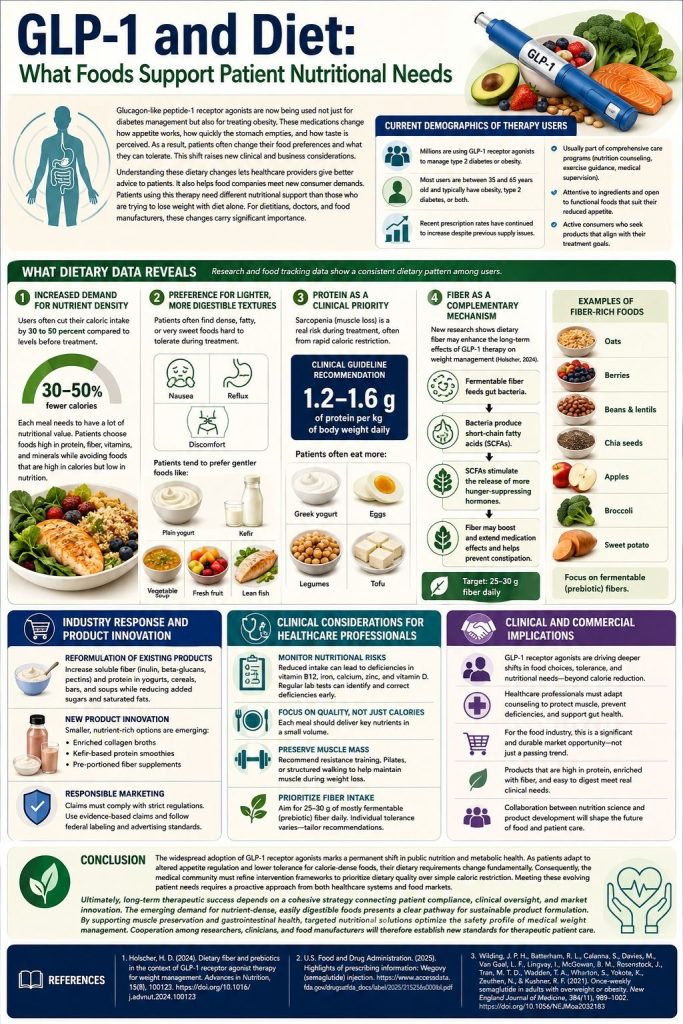
Research and food tracking data show a consistent dietary pattern among users. Several trends command clinical attention. Each trend relates to how appetite suppression and slowed stomach emptying work. Providers need to pay attention to these changing food preferences.
Increased Demand for Nutrient Density
Users often cut their caloric intake by 30 to 50 percent compared to levels before treatment. This drop means each meal needs to have a lot of nutritional value. Patients naturally start to choose foods that are high in protein, fiber, vitamins, and minerals, while steering clear of foods that are high in calories but low in nutrition.
Preference for Lighter, More Digestible Textures
Patients often find dense, fatty, or very sweet foods hard to handle during treatment. Nausea, reflux, and stomach discomfort are common side effects. For this reason, patients tend to prefer gentler foods like plain yogurt, kefir, vegetable soups, fresh fruit, and lean fish.
Protein as a Clinical Priority
Sarcopenia, or muscle loss, poses a real risk during treatment. This condition often results from rapid caloric restriction. Clinical guidelines usually recommend a daily protein intake of 1.2 to 1.6 grams for every kilogram of body weight. This means patients often eat more Greek yogurt, eggs, legumes, and tofu.
Fiber as a Complementary Mechanism
New research points out that dietary fiber might work well alongside pharmacotherapy. A review indicates that fiber supplements could enhance the long-term effects of these therapies on weight management (Holscher, 2024). While the weight loss from fiber alone is modest compared to drug effects, fiber serves a complementary role instead of a substitute.
The mechanism involves the gut microbiome. Fermentable fibers help gut bacteria produce short-chain fatty acids, which spur the body to release more hunger-suppressing hormones. Therefore, fiber could boost and extend the effects of medication. It also helps prevent constipation, a common side effect.
Industry Response and Product Innovation
Major food companies have seen this change in consumer behavior. National brands are starting to reformulate their existing products and develop new ones aimed at these particular consumers. These actions reflect both immediate clinical needs and ongoing business opportunities.
Reformulation usually increases soluble fiber content with specific ingredients. Manufacturers often use inulin, beta-glucans, and pectins along with higher protein levels. They add these ingredients to yogurts, cereals, bars, and soups while also cutting back on added sugars and saturated fats to improve nutrition.
New product types have also appeared. Smaller, nutrient-rich snacks are becoming a promising area for innovation. Examples include enriched collagen broths, kefir-based protein smoothies, and pre-portioned fiber supplements. These products offer concentrated, easy-to-digest nutrition for consumers.
Marketing claims for these products need to follow strict regulations. Statements like “high in fiber” or “supports satiety” must comply with federal labeling rules. Advertisements also need to align with federal advertising standards. Companies should use claims that have support from peer-reviewed research to remain credible.
Clinical Considerations for Healthcare Professionals
Clinicians overseeing patients on this therapy should focus on specific risk areas. Reduced food intake can lead to micronutrient deficiencies, especially in vitamin B12, iron, calcium, zinc, and vitamin D. Regular lab tests can help identify and fix these deficiencies early.
Nutritional counseling should emphasize quality over just counting calories. Each meal should aim to provide essential nutrients while keeping overall volume low. Clinicians should also recommend physical activities focused on building strength. Weight training, Pilates, or structured walking programs can help maintain muscle mass during weight loss.
Fiber intake requires particular attention as a complementary strategy. The recommended target is usually 25 to 30 grams daily. Healthcare providers should prioritize fermentable fibers that act as prebiotics. Individual tolerance to fibers can vary a lot among patients, so dietary recommendations should be tailored to each patient’s responses.
Clinical and Commercial Implications
These receptor agonists are changing dietary habits for millions of patients. This change is more than just reducing calories; it involves deeper shifts in food choices, tolerance, and nutritional needs. Healthcare professionals must adjust their counseling to support patient health.
For the food industry, this patient segment is an important market. It represents a stable consumer base rather than a passing trend. Products that offer high protein, fiber enrichment, and digestive ease meet real clinical needs. As a result, cooperation between nutrition science and product development will shape the future of food.
Conclusion
The widespread adoption of GLP-1 receptor agonists marks a permanent shift in public nutrition and metabolic health. As patients adapt to altered appetite regulation and lower tolerance for calorie-dense foods, their dietary requirements change fundamentally. Consequently, the medical community must refine intervention frameworks to prioritize dietary quality over simple caloric restriction. Meeting these evolving patient needs requires a proactive approach from both healthcare systems and food markets.
Ultimately, long-term therapeutic success depends on a cohesive strategy connecting patient compliance, clinical oversight, and market innovation. The emerging demand for nutrient-dense, easily digestible foods presents a clear pathway for sustainable product formulation. By supporting muscle preservation and gastrointestinal health, targeted nutritional solutions optimize the safety profile of medical weight management. Cooperation among researchers, clinicians, and food manufacturers will therefore establish new standards for therapeutic patient care.
References
Holscher, H. D. (2024). Dietary fiber and prebiotics in the context of GLP-1 receptor agonist therapy for weight management. Advances in Nutrition, 15(8), 100123. https://doi.org/10.1016/j.advnut.2024.100123
U.S. Food and Drug Administration. (2025). Highlights of prescribing information: Wegovy (semaglutide) injection. https://www.accessdata.fda.gov/drugsatfda_docs/label/2025/215256s000lbl.pdf
Wilding, J. P. H., Batterham, R. L., Calanna, S., Davies, M., Van Gaal, L. F., Lingvay, I., McGowan, B. M., Rosenstock, J., Tran, M. T. D., Wadden, T. A., Wharton, S., Yokote, K., Zeuthen, N., & Kushner, R. F. (2021). Once-weekly semaglutide in adults with overweight or obesity. New England Journal of Medicine, 384(11), 989–1002. https://doi.org/10.1056/NEJMoa2032183