Genetic Association Between GLP-1 Receptor Signaling and Reduced Psoriatic Disease Risk

A recent analysis using Mendelian randomization provides genetic evidence that links glucagon-like peptide-1 receptor expression to a reduction in psoriatic risks. A noteworthy connection was discovered by researchers between heightened receptor activity and diminished instances of psoriasis and psoriatic arthritis. These results broaden the scientific comprehension of this pathway beyond its conventional function in metabolic regulation.
Investigators employed a targeted framework by choosing specific genetic instrumental variables derived from whole blood data. This approach is effective at reducing the influence of confounding variables and reverse causation that are frequently present in observational studies. More than 36,000 psoriasis cases and 5,000 psoriatic arthritis cases were included in the analysis. Consequently, the considerable sample size grants the conclusions drawn a high degree of statistical power.
Genetic proxies suggest that rises in receptor expression are associated with a significantly lower psoriasis risk. The odds ratios identified in the data were 0.72 for psoriasis and 0.48 for psoriatic arthritis. These associations persisted even when cardiometabolic traits like body mass index and diabetes were taken into account. The results suggest the existence of a protective mechanism that does not depend on weight loss.
The suggestion of partial attenuation implies that the clinical benefits seen are not solely the result of metabolic improvement. Different methods were used in sensitivity analyses to confirm these directional findings across a variety of models. Such consistency reduces the likelihood that horizontal pleiotropy influenced the primary findings. The evidence, therefore, points to a direct immunomodulatory effect in the joints and skin.
The current research framework has several limitations. Mendelian randomization indicates genetic variation over a lifetime, as opposed to short-term pharmacological intervention. In addition, concentrating solely on European ancestry constrains the broader applicability to varied populations. Colocalization analyses did not yield definitive evidence for a shared causal variant either.
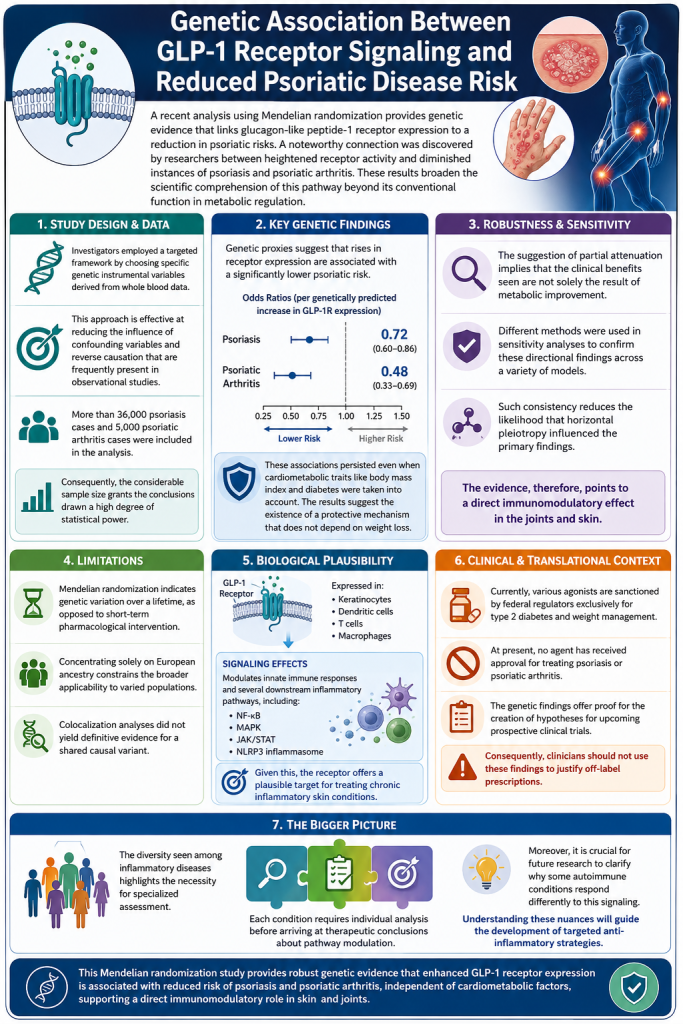
Biological data further support these results through known cellular mechanisms. Keratinocytes and immune cells involved in psoriasis pathogenesis express these specific receptors. Signaling through this pathway modulates innate immune responses and several downstream inflammatory tracks. Given this, the receptor offers a plausible target for treating chronic inflammatory skin conditions.
Currently, various agonists are sanctioned by federal regulators exclusively for type 2 diabetes and weight management. At present, no agent has received approval for treating psoriasis or psoriatic arthritis. The genetic findings offer proof for the creation of hypotheses for upcoming prospective clinical trials. Consequently, clinicians should not use these findings to justify off-label prescriptions.
The diversity seen among inflammatory diseases highlights the necessity for specialized assessment. Each condition requires individual analysis before arriving at therapeutic conclusions about pathway modulation. Moreover, it is crucial for future research to clarify why some autoimmune conditions respond differently to this signaling. Understanding these nuances will guide the development of targeted anti-inflammatory strategies.