Can Semaglutide Help People Quit Smoking?

Smoking is still one of the leading causes of preventable death worldwide. Because of this, doctors are always looking for new ways to help people quit.
Semaglutide, a drug widely known for treating type 2 diabetes and helping with weight loss has recently caught the attention of researchers. Newer studies are trying to answer an interesting question: Could this same medication help people give up cigarettes?
How GLP-1 Drugs Might Brain-Tweak Nicotine Cravings
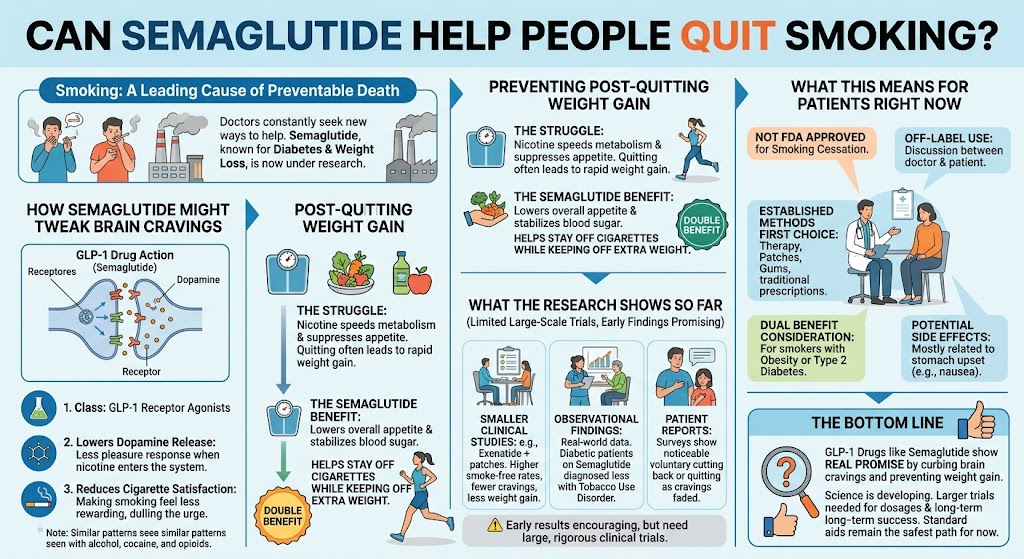
Semaglutide belongs to a class of drugs called GLP-1 receptor agonists. Aside from helping control blood sugar, these drugs interact with the brain’s reward system.
Early research shows that GLP-1 drugs lower the amount of dopamine released in the brain when nicotine enters the system. Dopamine is the chemical responsible for feelings of pleasure and reward. By dulling that dopamine spike, the drug might make smoking feel less satisfying, reducing the urge to light up.
Interestingly, researchers have seen this same pattern with other addictive substances, including alcohol, cocaine, and opioids.
Preventing Post-Quitting Weight Gain
One major reason people struggle to quit smoking or fall back into the habit is weight gain. Nicotine speeds up your metabolism and suppresses your appetite. When you quit, your appetite returns and your metabolism slows back down, often leading to rapid weight gain.
This is where semaglutide offers a double benefit. Because it lowers overall appetite and keeps blood sugar steady, it can prevent the extra weight people usually gain after quitting. Helping patients stay off cigarettes while keeping off extra weight addresses two problems at once.
What the Research Shows So Far
So far, large-scale clinical trials testing semaglutide specifically for smoking cessation are limited, but early findings look promising:
- Smaller Clinical Studies: An earlier study tested a similar GLP-1 drug called exenatide alongside traditional nicotine patches and counseling. Patients taking the drug were more likely to stay smoke-free after six weeks, reported fewer cravings, and gained less weight than those on a placebo.
- Observational Findings: Researchers looking at real-world health data found that diabetic patients prescribed semaglutide were diagnosed with tobacco use disorder far less often than those taking other diabetes drugs. They were also less likely to need traditional quit-smoking aids.
- Patient Reports: Surveys and self-reported data show that a noticeable number of patients taking GLP-1 drugs voluntarily cut back on smoking or quit altogether, simply because their cravings faded away.
While these results are encouraging, observational data and small trials can’t replace large, rigorous clinical trials.
What This Means for Patients Right Now
It is important to remember that semaglutide is not approved by the FDA or other regulatory bodies as a treatment for quitting smoking.
If a doctor and patient discuss using it this way, it is considered an “off-label” use. For now, established methods like behavioral therapy, nicotine patches, gums, or traditional quit-smoking prescriptions remain the first choice for treatment.
However, for patients who smoke and live with obesity or type 2 diabetes, semaglutide might offer a helpful dual benefit under a doctor’s care. Like any medication, it comes with potential side effects, mostly related to stomach upset like nausea or an uneasy stomach when first starting.
Limitations and Unanswered Questions
Existing evidence derives largely from observational studies and small randomized trials. Few studies have directly tested semaglutide for cessation outcomes. Sample sizes across published trials remain modest, limiting overall statistical power. Hence, larger, adequately powered trials are necessary before clinicians draw definitive conclusions.
Mechanistic studies in humans remain sparse compared with extensive preclinical literature. Neuroimaging research using functional magnetic resonance imaging is underway to clarify underlying pathways. Such studies aim to connect receptor-level mechanisms with observed behavioral outcomes in smokers. Until this research matures, causal claims about semaglutide warrant caution.
Dosing, treatment duration, and patient selection criteria also remain undefined for this application. Existing trials used varied GLP-1 receptor agonists, doses, and treatment durations. This heterogeneity complicates direct comparisons across studies and limits pooled analysis. Thus, standardized protocols will be essential for future regulatory consideration.
Conclusion
Current evidence positions GLP-1 receptor agonists as a promising tool for smoking cessation. Preclinical mechanisms involving dopamine suppression and habenular signaling provide biological plausibility. Early randomized trials and observational studies report encouraging associations with reduced cravings. Nevertheless, the evidence base remains preliminary and insufficient for a formal clinical indication.
Ongoing trials examining semaglutide directly will clarify these remaining questions. Clinicians should monitor this evolving evidence while relying on approved cessation therapies. Should confirmatory trials succeed, semaglutide could offer dual benefits for patients managing nicotine dependence and weight. For now, its role in smoking cessation remains an active area of investigation.
References
- Budzyński, J., Czarnecki, D., Kruszewski, M., Długosz, A., & Ziółkowski, M. (2024). The effect of glucagon-like peptide 1 receptor agonists on alcohol and tobacco craving among patients with type 2 diabetes mellitus: A cross-sectional, questionnaire pilot study. Medical Research Journal, 9(3), 247 to 253. https://doi.org/10.5603/mrj.101513
- Ejtahed, H. S., et al. (2019). Cigarette smoking, type 2 diabetes mellitus, and glucagon-like peptide-1 receptor agonists as a potential treatment for smokers with diabetes: An integrative review. Diabetes Research and Clinical Practice, 149, 78 to 88. https://doi.org/10.1016/j.diabres.2019.01.033
- Alharbi, S., et al. (2026). The use of GLP-1 receptor agonists and subsequent risk of nicotine-related events: A cross-sectional study. BMC Public Health. https://doi.org/10.1186/s12889-026-26474-6