Weight Loss Options Explained: Bariatric Surgery and the Rise of GLP-1 Injections

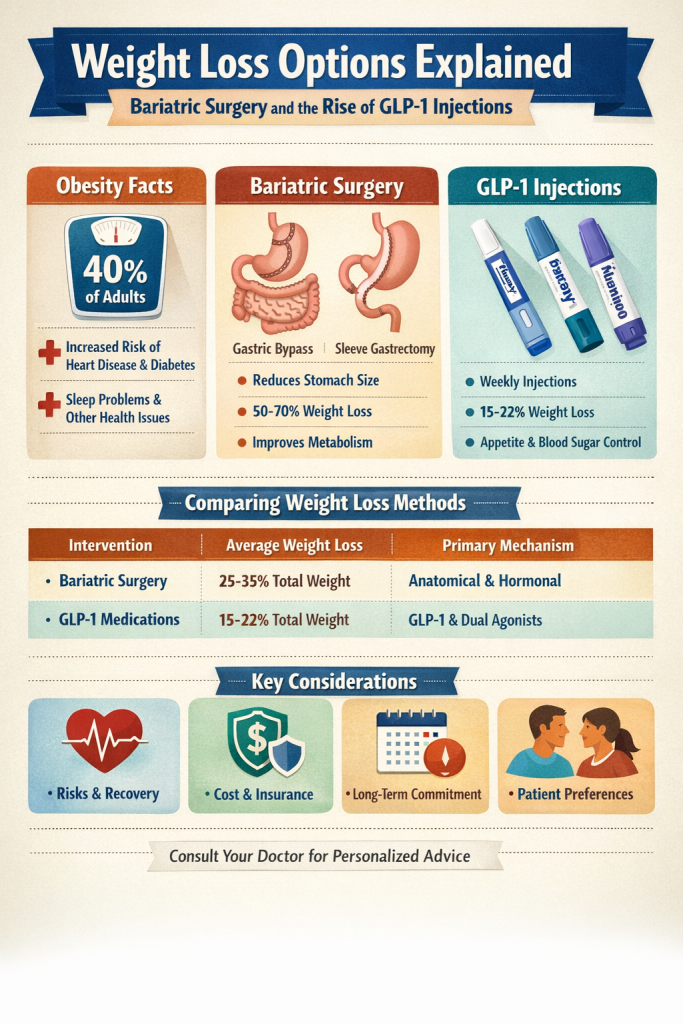
Obesity is a major health hurdle that many people face today. More than 40 percent of adults now live with this condition. Carrying extra weight increases the risk of heart disease and diabetes. Along with this, it can lead to sleep issues and other serious illnesses.
Managing weight requires a plan based on solid medical facts. Doctors must pick a treatment that fits the specific needs of each person. The options for care have grown a lot lately. This includes well-known surgeries and new types of weekly shots.
Bariatric Surgery: Established Mechanisms and Outcomes
Bariatric surgery refers to several operations that help people eat less. These procedures also change how the body handles hunger signals. Gastric bypass and sleeve gastrectomy are the two most common choices. Each one changes the stomach to help a person feel full faster.
Furthermore, these surgeries change how the gut interacts with food. These shifts help fix metabolism in ways that dieting alone cannot do. The body actually starts to burn energy more effectively after the procedure. Consequently, many patients see a huge improvement in their overall health.
Clinical trials show that these surgeries lead to very large weight loss. Most people lose between 50 and 70 percent of their extra weight. These results usually stay steady for at least two years. Moreover, surgery often cures or improves high blood pressure and diabetes.
| Intervention | Typical Weight Loss | Primary Mechanism |
| Bariatric Surgery | 25% to 35% Total Weight | Anatomical and Hormonal |
| Semaglutide (2.4 mg) | 15% Total Weight | GLP-1 Receptor Agonism |
| Tirzepatide (15 mg) | 20% to 22% Total Weight | Dual GLP-1/GIP Agonism |
These results happen because the surgery fixes both the body and the hormones. It addresses the physical size of the stomach and the chemical signals. This makes it a very powerful tool for those with severe obesity. Accordingly, it remains a top choice for long-term health success.
Keeping the weight off over many years can be a challenge. Success often depends on the type of surgery and lifestyle habits. Some people may start to gain weight back after five years. This can happen for many different reasons, like stress or physical changes.
In view of this, doctors are starting to use new medications. These shots can help people who start to regain weight after surgery. This combination helps keep the initial weight loss stable over time. Such plans offer a better safety net for long-term health.
Getting surgery requires a deep look at a person’s medical history. Usually, it is recommended for those with a very high body mass. This typically means a score of 40 or higher on the index. People with a score of 35 may also qualify if they have other illnesses.
Nevertheless, surgery comes with risks that patients must think about carefully. It requires a lifetime of taking vitamins and eating very specific meals. These big life changes can be hard for some people to maintain. Thus, talking to a team of experts is the best first step.
GLP-1 Receptor Agonists: Pharmacology and Clinical Application
GLP-1 shots are a new way to treat weight and metabolic health. These drugs act like a natural hormone that the body makes. This hormone tells the brain when the stomach is full after eating. It also helps the body manage insulin much better than before.
These shots work on the brain, the stomach, and the pancreas. This multi-part approach is why the weight loss is so strong. Many large studies have proven that these drugs work very well. Therefore, they are now a popular alternative to more invasive options.
One drug, called semaglutide, has shown great results in many patients. A major study found that people lost about 15 percent of their weight. This happened over roughly 68 weeks of using the weekly shot. Notably, these results are very close to what some surgeries achieve.
Federal agencies have now approved this drug for long-term weight use. It is a great option for adults who struggle with weight related health. This drug has changed how doctors think about treating obesity daily. Given this, it is now a standard part of modern medicine.
Another drug, tirzepatide, works in two different ways at the same time. It targets two hormones instead of just one to boost results. This leads to even more weight loss than the earlier medications. Some patients in trials lost over 20 percent of their weight.
These results are some of the highest ever seen from a medication. Consequently, this drug has raised the bar for what shots can do. It offers a level of help that was once only possible through surgery. Thus, it is a major win for patients seeking non-surgical help.
Comparative Analysis: Surgery Versus Pharmacotherapy
Surgery still provides the biggest amount of weight loss for most people. It remains the most powerful way to lose a lot of weight quickly. However, the new shots are closing the gap very fast. Some of the newest drugs are starting to match surgical results.
Furthermore, there are not many studies that compare the two directly. We still need more information on how the shots work after many years. More data is being collected every day from people using these drugs. Building on this, doctors will soon have a clearer picture of success.
Both surgery and shots help people manage their blood sugar levels. Surgery can actually make type 2 diabetes go away for many people. This often happens because of the hormone changes after the operation. Similarly, the new shots lower blood sugar and help the liver.
They work through different paths to reach the same healthy goal. Doctors now see both tools as great ways to treat diabetes. Many clinics use a mix of both depending on the patient. Hence, the focus is always on making the patient healthier.
Both treatments also help people feel better in their daily lives. Surgery helps people move more easily and feel better about themselves. Studies show that patients often feel a big boost in happiness. The new weight loss shots show very similar mental health gains.
These drugs help lower the stress that comes with struggling with weight. Doctors look at these feelings when they decide which treatment is best. Using numbers alone does not tell the whole story of a patient. Accordingly, a person’s happiness is a very important part of care.
Reducing the risk of heart attacks is another big goal of treatment. A major study showed that semaglutide helps protect the heart. This is very important for patients who already have heart issues. Surgery also helps the heart, but the data is a bit different.
We do not have the same kind of long-term trial for surgery yet. In light of this, the shots currently have stronger proof for heart protection. This might lead a doctor to pick the shot for a high-risk patient. Therefore, heart health is a major factor in the final choice.
Safety Profiles and Clinical Considerations
Surgery has some risks that happen right after the operation or later. These risks are why patients need a lot of support from their doctors. Some people might deal with blood clots or issues with the lungs. Each problem needs fast and professional medical help to stay safe.
Long-term issues can include not getting enough vitamins from food. Some people might also experience “dumping syndrome” after they eat. This is why following a strict diet after surgery is so important. Accordingly, staying in touch with a medical team is the key.
The new shots are generally very safe for most people to use. Most side effects are related to the stomach, like feeling sick. These issues usually go away after the body gets used to the dose. Using a slow start helps make the drug much easier to handle.
Most people do not have to stop the drug because of these effects. There have been some questions about rare risks in animal studies. However, these risks have not been seen as a trend in humans. Meanwhile, doctors keep a very close watch on every patient.
Doctors must look at the risks of both paths very carefully. They have to balance the high weight loss of surgery with its risks. The shots have fewer risks but might require a long-term commitment. This balance is different for every person who walks into the office.
This is especially true for those who have a moderate amount of weight. Given this, a simple “one size fits all” plan does not work well. Every person needs a plan that fits their life and their health. Thus, the best choice comes from a deep talk with a doctor.
Access, Cost, and Health Equity Considerations
The high cost of the shots is a big problem for many. These medications can cost over $1,000 every single month. Many insurance plans do not cover them for weight loss yet. Accordingly, many people who need them simply cannot afford the price.
This creates an unfair gap in who gets the best healthcare. This is a major issue that leaders are trying to fix right now. There are many talks happening at the high levels of government. As a result, we may see the prices come down in the future.
The rules for which drugs are covered are changing every day. Some big insurance companies have started to pay for these weight shots. However, the paperwork to get them can still be very hard. Medicare has also started to cover more options for patients recently.
This shows that leaders now see obesity as a serious chronic illness. These changes are moving the focus toward better overall care. Treating weight is now seen as the best way to prevent other diseases. Thus, the health system is slowly becoming more helpful for patients.
Surgery requires a special hospital and a team of expert doctors. It also needs a long program of support before and after. Most insurance plans do cover these surgeries if a person qualifies. In view of this, some people still live too far from these centers.
This makes it hard for everyone to get the same level of care. Fixing these gaps is a major goal for many health leaders. This requires a lot of work from hospitals and the public. Therefore, making care easy to reach is just as important as medicine.
Clinical Decision Making and Patient Centered Selection
Choosing between surgery and a shot is a very personal decision. Doctors look at health history, goals, and what the patient wants. A person with many health issues might do better with surgery. This path offers a very strong fix for the entire body.
Meanwhile, some people may prefer the shot because it is not surgery. They might not want the risks that come with an operation. Using a shared plan helps the doctor and patient work together. Building on this, the final plan will be much more successful.
New research shows that using both tools together can be very effective. Some doctors give the shot before surgery to help the patient get ready. This can make the surgery safer and easier for the body. Along with this, it can help prevent weight gain later on.
Future studies will help us find the perfect mix for every person. Combining these two paths might be the future of weight care. It allows for a plan that changes as the patient gets healthier. Consequently, the way we treat obesity is becoming much more flexible.
Conclusion
The world of weight loss medicine has changed in a big way. New drugs have given people more choices than they ever had before. Surgery is still the strongest way to lose a lot of weight. Nevertheless, the new shots are proving to be very powerful tools.
Heart health data is making these shots even more popular today. As we learn more, doctors will get better at picking the right path. We must think about cost, health, and what the patient prefers. Both ways will be important for helping people live longer lives.
References
Jastreboff, A. M., Aronne, L. J., Ahmad, N. N., Wharton, S., Connery, L., Alves, B., Kiyosue, A., Zhang, S., Liu, B., Bunck, M. C., & Stefanski, A. (2022). Tirzepatide once weekly for the treatment of obesity. New England Journal of Medicine, 387(3), 205-216. https://doi.org/10.1056/NEJMoa2206038
Lincoff, A. M., Brown-Frandsen, K., Colhoun, H. M., Deanfield, J., Emerson, S. S., Esbjerg, S., Hardt-Lindberg, S., Hovingh, G. K., Kahn, S. E., Kushner, R. F., Lingvay, I., Oral, T. K., Michelsen, M. M., Plutzky, J., Tornoe, C. W., & Ryan, D. H. (2023). Semaglutide and cardiovascular outcomes in obesity without diabetes. New England Journal of Medicine, 389(24), 2221-2232. https://doi.org/10.1056/NEJMoa2307563
Schauer, P. R., Bhatt, D. L., Kirwan, J. P., Wolski, K., Aminian, A., Brethauer, S. A., Navaneethan, S. D., Singh, R. P., Pothier, C. E., Nissen, S. E., & Kashyap, S. R. (2017). Bariatric surgery versus intensive medical therapy for diabetes: 5-year outcomes. New England Journal of Medicine, 376(7), 641-651. https://doi.org/10.1056/NEJMoa1600869Wilding, J. P. H., Batterham, R. L., Calanna, S., Davies, M., Van Gaal, L. F., Lingvay, I., McGowan, B. M., Rosenstock, J., Tran, M. T. D., Wadden, T. A., Wharton, S., Yokote, K., Zeuthen, N., & Kushner, R. F. (2021). Once-weekly semaglutide in adults with overweight or obesity. New England Journal of Medicine, 384(11), 989-1002.https://doi.org/10.1056/NEJMoa2032183