Shifting GLP-1 Research and Development: Lessons From the First Generation

Glucagon-like peptide-1 (GLP-1) drugs have completely changed how doctors manage obesity and type 2 diabetes over the last twenty years. Early medicines like semaglutide and tirzepatide showed remarkable success, but real-world use also exposed some clear drawbacks. Because of those lessons, researchers are now building a whole new wave of treatments. These newer options do not just focus on shedding pounds, but also aim to protect muscle mass, lower costs, and improve long-term health.
This new pipeline shows how much the field has matured. Instead of taking a one-size-fits-all approach, scientists now design drugs to solve the exact problems patients experienced with older shots. Everything from how the medication enters the body to how clinical trials measure success is getting an upgrade.
Looking Back at First-Generation Results
Access Issues and Why People Stop Treatment
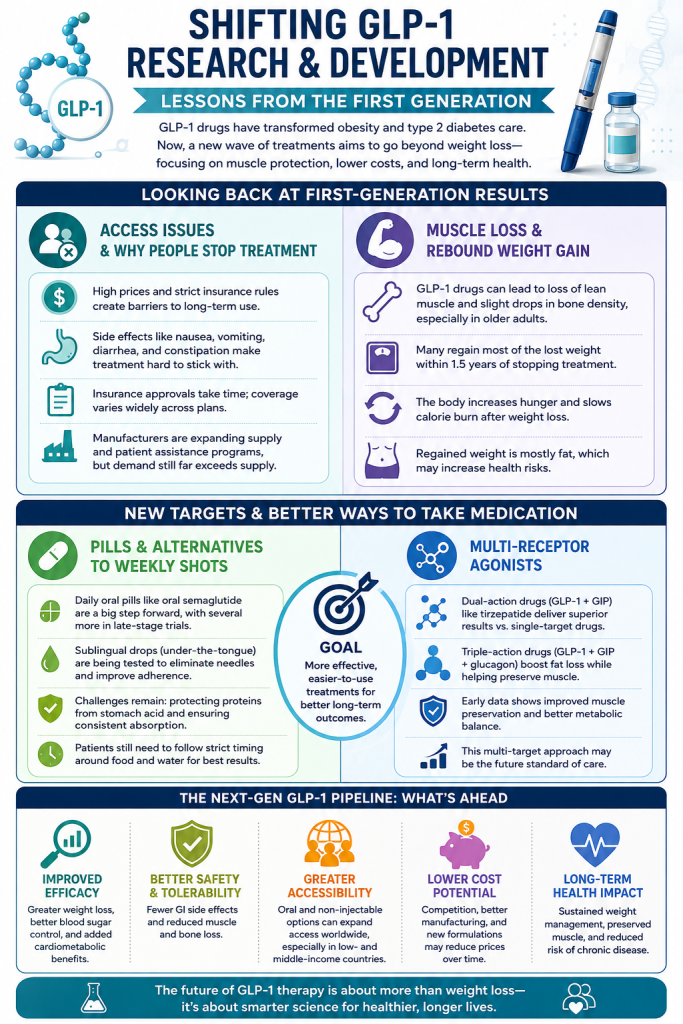
Even though early GLP-1 drugs work well, many people stop using them within their first year. High prices and strict insurance rules make it hard for folks to stay on them long-term. On top of that, common side effects like severe nausea, vomiting, diarrhea, and constipation make the routine tough to stick with. As a result, drug makers now focus just as much on reducing stomach upset as they do on burning fat.
Doctors also notice that patients often get frustrated during the early weeks of treatment. Some people give up too soon because the weight comes off slower than they expected. Others struggle with the slow dosing schedule required to keep stomach issues at bay. These everyday challenges have become a top priority for teams designing next-generation options.
Insurance headaches add another layer of trouble. Coverage varies wildly depending on the plan, and getting approval can take weeks of paperwork. These delays often stall care for people who need it most.
To help out, manufacturers have created patient assistance programs and expanded factories to build up supply. Still, the demand for these drugs stays much higher than what companies can make. Economists are now studying whether these medications save money over time by preventing heart attacks and kidney failure. If the math checks out, insurance companies might finally start covering them more widely.
Muscle Loss and Rebound Weight Gain
Newer studies reveal another concern: people on GLP-1s often lose healthy muscle alongside body fat. That is especially risky for older adults, who can easily become fragile if they lose muscle strength. Doctors have also noticed slight drops in bone density, though they are still studying what that means for long-term health. Because of this, preserving lean muscle is now a core goal for new drug trials.
Another major issue is what happens when people stop taking the medication. Many regain most of the lost weight within a year and a half. When someone drops a lot of weight, their body reacts by boosting hunger signals and slowing down calorie burn. If they also lost muscle, their baseline metabolism drops even lower. When the weight comes back, it is mostly fat, which actually leaves them at a higher risk for health problems than before.
New Targets and Better Ways to Take Medication
Pills and Alternatives to Weekly Shots
Pharmaceutical companies are working hard to make these treatments easier to take. For years, weekly injections were the only choice, but daily pills are quickly gaining ground. The approval of oral semaglutide was a huge step forward, and several other daily pills are currently moving through final clinical trials.
Researchers are also testing options like sublingual drops that dissolve under the tongue. The goal is simple: eliminate the need for needles so patients feel more comfortable sticking with their treatment. If these non-shot options succeed, millions more people around the world will be able to access care. However, mass-producing stable pills that survive normal storage remains a tough technical challenge.
Getting the body to absorb proteins through the stomach is notoriously tricky. Stomach acid usually breaks down peptides before they can do their job, so scientists have to use special protective coatings. Doctors also have to remind patients about strict timing around food and water when taking pills. Finding the right balance between convenience and reliable absorption is an ongoing puzzle.
Multi-Receptor Agonists
Instead of targeting just one hormone, scientists are now building single molecules that switch on two or three receptors at once. For instance, dual-action drugs like tirzepatide combine GLP-1 with a second hormone called GIP, delivering much stronger results than older single-target drugs. Newer “triple-action” drugs add a third hormone (glucagon) into the mix. This combination curbs appetite while simultaneously helping the body burn more calories.
These multi-hormone drugs also seem to do a much better job of protecting lean muscle. Early data suggests that adding glucagon balances out the metabolic effects that cause muscle loss with single-target shots. This multi-target strategy has quickly become the hottest trend in metabolic research.
Scientists are still tweaking the exact recipe for these combination drugs to figure out what ratio works best. Preclinical tests help show which mix burns maximum fat with the fewest side effects. Researchers are also using advanced body scans during trials to track muscle versus fat directly, rather than relying on a basic bathroom scale.
Finding the right dose for multi-target drugs takes careful fine-tuning. Higher doses usually mean faster weight loss, but they can also bring back painful stomach side effects. To fix this, doctors are moving away from rigid step-by-step schedules and toward personalized plans based on how each person reacts.
Moving Beyond Basic Weight Loss
Treating Related Health Conditions
Obesity is linked to roughly two hundred different health conditions, and drug development is finally reflecting that reality. Semaglutide is already approved to lower the risk of heart attacks and strokes in high-risk patients, and it also slows down chronic kidney disease. Meanwhile, tirzepatide earned approval to treat severe sleep apnea in people struggling with weight.
Other candidates in testing show promise for reducing joint pain from knee osteoarthritis. Dozens of new drugs in development specifically target liver disease, diabetes, and heart failure. Researchers are even running trials to see if these molecules can protect against memory loss in diseases like Alzheimer’s and Parkinson’s.
Today, a successful weight-loss drug needs to do more than just lower a number on the scale. Regulators, doctors, and insurance providers want proof that a treatment protects major organs. Because of this shift, clinical trials now measure things like heart health and kidney function right alongside weight loss.
New Mechanisms Beyond Incretin Hormones
Scientists are also building treatments that do not rely on GLP-1 pathways at all. Amylin agonists, for example, work on a completely different brain pathway to trigger feelings of fullness. Other experimental drugs block specific proteins that cause muscle wasting, helping patients hold onto lean muscle while losing fat. These unique approaches could eventually be combined with regular GLP-1 shots for better overall results.
Another fascinating area of research involves metabolic accelerators. These oral treatments help cells burn extra energy while at rest. Older versions of these drugs were far too dangerous because they caused body temperatures to spike to unsafe levels. Newer versions target the liver specifically, keeping the rest of the body safe while boosting metabolism.
Gene-silencing therapies using RNA represent another exciting frontier. These treatments reduce specific proteins in the liver, which prompts the body to break down stubborn visceral fat around organs. Early tests show these therapies can also boost insulin sensitivity, helping the body manage blood sugar much better.
These novel therapies are being tested on their own and as add-ons to existing treatments. Researchers are looking into “sequencing” strategies, where a patient takes one type of drug to lose fat, then switches to another to preserve muscle and maintain results. While we still need long-term studies to confirm the best schedules, these options open up brand-new possibilities for care.
Measuring Long-Term Success
Better Tools to Track Progress
Current regulatory rules still focus almost entirely on raw weight loss, which creates a bit of a roadblock for newer, multi-purpose drugs. There are not many standard guidelines for approving drugs that focus on muscle retention or overall energy levels rather than pure scale weight. As treatments get smarter, approval frameworks will need to update their rules.
To get a clearer picture, researchers now use advanced tools like DEXA scans to look beneath the surface. These scans show exactly where fat is coming off and whether muscle is staying intact. Exercise tests, like measuring walking distance or oxygen levels during movement, help prove whether a patient’s everyday life is actually improving.
Proving that weight loss lasts over time is another huge goal for upcoming drugs. Researchers now carefully track how much weight patients regain a full year after stopping treatment. This metric helps distinguish drugs that offer lasting metabolic changes from those that require non-stop maintenance.
Conclusion
The world of GLP-1 research has moved way past the simple, first-generation shots. Lessons about side effects, muscle preservation, and rebound weight gain now shape how every new drug is built. With over one hundred clinical trials actively running worldwide, the choices available to patients will look completely different in just a few years.
Big investments from biotech and pharmaceutical teams continue to fuel rapid breakthroughs. Multi-target medications, daily pills, and muscle-sparing treatments are turning weight management into a precise, science-backed field. Experts expect that combination therapies will soon become the standard way doctors treat metabolic health.
As regulatory agencies adjust to these broader health metrics, patients will get access to care tailored specifically to their bodies. Instead of relying on a single option, the future of metabolic medicine is all about long-term, personalized support that lasts.
References
American Diabetes Association. (2024). Standards of care in diabetes, 2024. Diabetes Care, 47(Supplement_1), S1-S321. https://doi.org/10.2337/dc24-SINT
Jastreboff, A. M., Aronne, L. J., Ahmad, N. N., Wharton, S., Connery, L., Alves, B., Kiyosue, A., Zhang, S., Liu, B., Bunck, M. C., & Stefanski, A. (2022). Tirzepatide once weekly for the treatment of obesity. New England Journal of Medicine, 387(3), 205-216. https://doi.org/10.1056/NEJMoa2206038
Wilding, J. P. H., Batterham, R. L., Calanna, S., Davies, M., Van Gaal, L. F., Lingvay, I., McGowan, B. M., Rosenstock, J., Tran, M. T. D., Wadden, T. A., Wharton, S., Yokote, K., Zeuthen, N., & Kushner, R. F. (2021). Once-weekly semaglutide in adults with overweight or obesity. New England Journal of Medicine, 384(11), 989-1002. https://doi.org/10.1056/NEJMoa2032183