Retailers Introduce Legal Waivers Amid Weight Loss Trends

The rapid adoption of GLP-1 receptor agonists creates new challenges for bridal retailers. These medications facilitate significant weight loss over several months. Consequently, retailers now require customers to sign formal legal waivers. These documents acknowledge that physical changes may affect garment fit.
GLP-1 agents like semaglutide and tirzepatide produce sustained body weight reductions. Patients often lose up to 22 percent of their total mass. In light of this, ordering gowns months in advance becomes risky. Retailers face logistical exposure when garments no longer fit.
Bridal retailers usually manufacture gowns to specific order requirements. These garments often possess very limited alteration margins. Standard adjustments only accommodate minor size fluctuations. Therefore, rapid weight loss often exceeds these structural limits.
Completed gowns may become unalterable if the wearer loses excessive weight. Retailers now formalize risk acknowledgment through written contracts. This shift moves contractual liability directly to the consumer. Thus, businesses protect themselves from the costs of replacement.
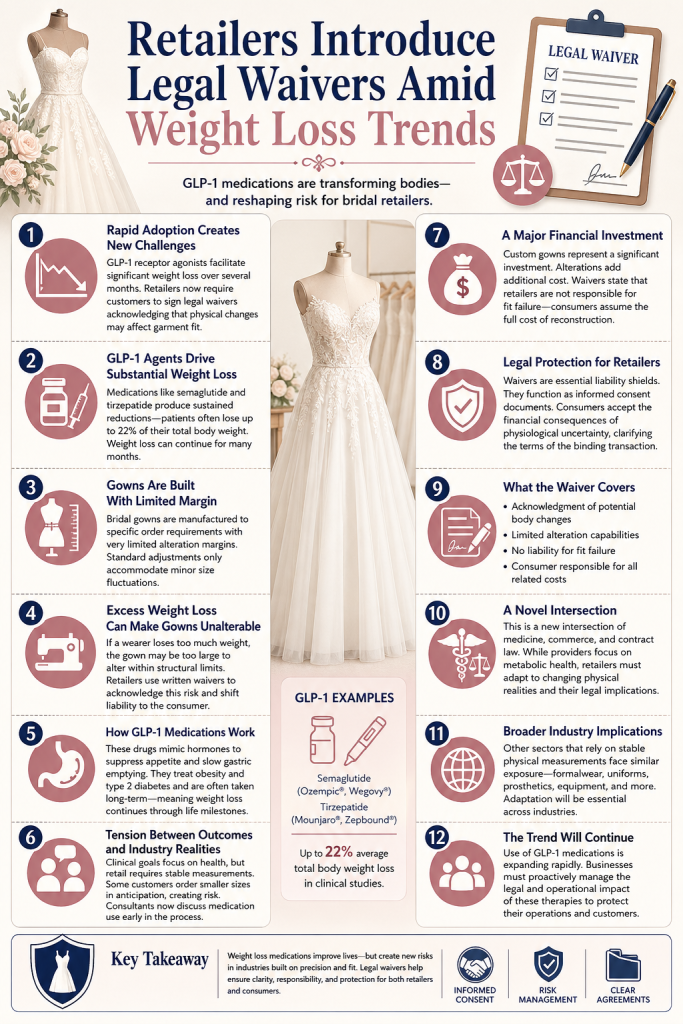
GLP-1 medications mimic hormones to suppress appetite and slow gastric emptying. These drugs effectively treat obesity and type 2 diabetes. Patients often remain on these therapies for extended periods. Accordingly, weight loss continues through major personal milestones.
A tension exists between clinical outcomes and industries requiring stable measurements. Retailers report that customers often request smaller sizes in anticipation of loss. This practice introduces significant risk to the fitting process. Given this, some consultants now discuss medication use early.
Custom gowns represent a major financial investment for most consumers. Alteration costs typically accumulate as a separate expense. Waivers specify that retailers bear no responsibility for fit failure. As a result, the consumer assumes the full cost of reconstruction.
These legal instruments serve as essential liability shields for businesses. They also function as informed consent documents for the buyer. Consumers must accept the financial consequences of physiological uncertainty. Consequently, the waiver clarifies the terms of the binding transaction.
The intersection of medicine and contract law represents a novel challenge. Medical providers focus on metabolic health rather than commercial impacts. Nevertheless, the bridal industry must adapt to these changing physical realities. This response illustrates a broader shift in consumer behavior.
Similar contractual adaptations may soon emerge in other specialized sectors. Any industry reliant on stable physical measurements faces comparable risks. Use of these medications continues to expand across the general population. Therefore, businesses must proactively manage the legal results of these therapies.